
Loading
Foundation of the Firm and the Founder’s Biography
The company J.M. Schmidt was founded in Amsterdam in 1866 by the optician Johan Michaël Schmidt. Schmidt was born in 1830 in Amsterdam to a family of German origin. According to some accounts, his father was one of the itinerant German peddlers of spectacles who went from village to village with their trays. Johan Michaël first trained as a goldsmith and restorer: before opening his own business he repaired items made of gold and silver. At about the age of 36 Schmidt decided to apply his skills in a new field and in 1866 opened a small workshop-shop for optical instruments and spectacles in the center of Amsterdam. The first shop was located at Sint Nicolaasstraat 44, near the railway station.
Initially J.M. Schmidt specialized in the manufacture and repair of spectacles (he ground lenses himself and made frames) and in the trade of optical instruments. The range soon expanded, however. In 1873 he moved the firm to a busier location—the corner of Wijde Kapelsteeg and Rokin. The new shop received the name “Magazijn De Gouden Bril” (“The Golden Spectacles Store”). In the narrow lane of Wijde Kapelsteeg No. 1 became known for its sign in the form of a gilded pair of spectacles that symbolized the company’s profile. Business was good and over time the premises became cramped: in 1885 the old building was demolished and a more spacious one erected in its place. On the pediment of the new house a symbolic stucco lorgnette was fixed, and on the hoisting beam—miniature spectacles commemorating the shop’s name. These decorative details have survived to this day, testifying to the continuity of the shop.
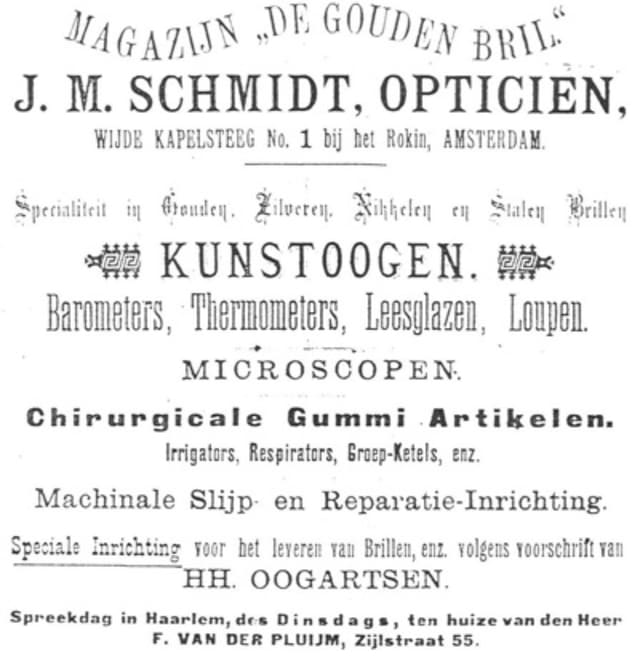
Johan Michaël Schmidt managed the firm until the mid-1880s. In 1886 he stepped back from affairs, handing the business over to the next generation. The founder left behind a well-established brand and a well-run enterprise. J.M. Schmidt gained the reputation of a respected optician and supplier of instruments closely connected with the scientific and medical community of Amsterdam. For example, he worked to ophthalmologists’ prescriptions and supplied complex spectacles for the patients of eye doctors. An advertisement for “Magazijn De Gouden Bril” (c. 1875) at the Rokin/Wijde Kapelsteeg corner lists a wide assortment: silver, nickel and steel spectacles, artificial eyes, barometers, thermometers, magnifying glasses (loupes), microscopes, surgical rubber goods, and more. Schmidt also regularly held consultations in other cities (for instance, once a week he traveled to Haarlem to see clients). Thus the biography of Johan Michaël Schmidt is a typical example of a successful 19th-century entrepreneur who combined craft mastery (goldsmithing and optics) with commercial acumen and scientific-technical curiosity.
Activities of the Firm: Optics and Meteorological Instruments
From the outset J.M. Schmidt positioned itself not only as a spectacles shop but also as a supplier of a variety of optical and scientific instruments. Advertisements in the 1870s emphasized that, in addition to all types of corrective spectacles, one could purchase at Schmidt’s theatrical and field binoculars, loupes, microscopes, as well as specialized goods—such as artificial ocular prostheses (glass eyes). Especially noteworthy is that meteorological instruments entered the range from an early date: barometers, thermometers, barographs, hygrometers, etc. This is confirmed both by 19th-century advertising texts and by later historical overviews: “before the digital era, traditional barometers, barographs and hygrometers were always offered for sale at Schmidt’s.” Thus the firm J.M. Schmidt effectively acted in Amsterdam as a shop for scientific instruments, serving the needs of technology enthusiasts as well as professional physicians, scientists, seafarers, and so on.
In addition to meteorological and optical goods, J.M. Schmidt offered other scientific-medical supplies. An 1875 advertisement attests to the sale of surgical instruments and rubber medical items (for example, irrigators, inhalers, respirators, “croup kettles” for treating diphtheria with steam, etc.). It is known, for instance, that in the late 19th century Schmidt sold artificial ocular prostheses for patients who had lost an eye—glass eyeballs in various sizes and iris shades. These prostheses were handcrafted by the German glassblower Müller from Wiesbaden, who once a year personally came to Amsterdam and saw clients at the Parkhotel. Thus the firm’s assortment covered a broad spectrum of technical and medical equipment, which made Magazijn “De Gouden Bril” a unique scientific-instrument shop in Amsterdam at the turn of the 19th to the 20th century.
The Family Nature of the Business and Generational Succession
From the very beginning the firm J.M. Schmidt was a family enterprise. The founder, Johan Michaël Schmidt, brought his children into the business, ensuring the transmission of knowledge and reputation by inheritance. After 1886 management passed to representatives of the second generation of the Schmidt family. The business successfully outlived its founder and continued to develop under the management of his descendants up to the mid-20th century. The generations of the Schmidt family who headed the company are listed below:
After the Second World War the dynastic leadership ceased. In 1948 Annie Schmidt left her post, and the company for the first time passed under the management of people from outside the family. Nevertheless the company name was preserved, and the successors strove to adhere to the established quality standards. The firm was transformed into a public limited company (N.V.) and continued under hired directors: first G. Temmink (active since 1928, formally director from 1948 to 1959), then P. Kater, A. Heemskerk, and others. Despite the loss of family control, the J.M. Schmidt brand remained well known in the optics market. The shop on Rokin received in 1939 the honorary status Hofleverancier (“Royal Warrant holder”)—a royal decree by Prince Bernhard allowed the firm to call itself a purveyor to the court. This title was confirmed again in 2006 by Queen Beatrix, which speaks to the company’s consistently strong reputation over the decades.
Thus three generations of the Schmidt family managed not only to found but also to develop and keep the enterprise in leading positions in its field. By 1948 J.M. Schmidt had become the oldest and one of the most respected optical firms in the Netherlands. Although management later passed to other owners, the business continued to rest on the same principles laid down by the Schmidt family: high quality instruments, the ability to combine retail trade with craft service (manufacture and repair), and a constant expansion of the range in step with scientific and technological progress.
Mentions in Sources, Catalogues and Museums
The history of the firm J.M. Schmidt is well traceable through historical sources—newspapers, address books, archival documents, and museum holdings. Already in the 1870s the shop’s advertisements appeared regularly in the press. Thus the Amsterdam Address Calendar for 1875–1876 published an advertisement “Magazijn De Gouden Bril – J.M. Schmidt, Opticien” listing the main goods: spectacles of gold, silver, nickel, and steel, barometers, thermometers, magnifying glasses, loupes, microscopes, artificial eyes, and even surgical rubber supplies. The advertisement emphasized the presence of a lens-grinding workshop and special terms for making spectacles to ophthalmologists’ prescriptions, which indicates the firm’s serious technical base already at that time.
In 1879 advertising for Schmidt’s optics also appeared in the Jewish newspaper Nieuw Israëlitisch Weekblad, aimed at Amsterdam’s Jewish community. This shows that the shop sought to reach a wide circle of clients of all faiths and social strata. Already then it was noted that the firm stood on the same Rokin–Wijde Kapelsteeg corner where it is located to this day, and that it is “the oldest optical shop in the country” (notably, this phrase remains true 150 years later).
Historical address books record the evolution of the firm and its branches. According to archival data, the addresses of J.M. Schmidt changed as follows:
As can be seen, the firm not only established itself in the historic center but also expanded by opening branches in the suburbs. The main shop, however, invariably remained on Rokin.
Of special interest is the building at Rokin 72, known as “De Gouden Bril.” In 1917–1918, after the demolition of old structures at the corner of Rokin and Wijde Kapelsteeg, a new corner building was erected for Schmidt’s optics to the design of the architect P. van Dijk. The building is executed in the style of late Neo-Dutch Renaissance with elements of “transitional architecture” (Nieuw Historiserende vormen). The façade is adorned with references to the shop’s profile: at the very corner a sculpture of a monkey with binoculars is placed at the top, and on the alley wall—a figure of a spectacle-wearer (an allegorical nod to optical instruments). The ground floor is clad in wood and decorated with stained glass bearing the shop’s name and street number. The 1918 interior, furnished by J.B. Hillen, has been preserved in part to this day in authentic form. For its unique historical setting the shop has been included in the list of newly protected monuments (Rijksmonumenten) of the Netherlands.
The current appearance of the “De Gouden Bril” building at the corner of Rokin 72 – Wijde Kapelsteeg (built in 1918) shows the brand emblems: a sign in the form of golden spectacles and the royal coat of arms with the inscription “Bij Koninklijke Beschikking Hofleverancier” (Royal Warrant). After 1948 the shop continued to operate under the name Schmidt Optiek, remaining in its historic location.
Collections of technical museums and antique catalogues also preserve the memory of J.M. Schmidt products. For example, the collection of the Carl Zeiss Museum (Jena) contains samples of late-19th-century spectacles sold by Schmidt—elegant 1870s pince-nez with oval blue lenses and folding sides. In the firm’s account books for 1886 purchases of spectacle frames from German and French manufacturers (Minot, Goldschmidt, Carl Appel, etc.) are noted, confirming the company’s international ties.
Finally, official honors and titles are an important testimony to the firm’s status. As already mentioned, in 1939 J.M. Schmidt received the designation Hofleverancier (Royal Warrant holder). A bronze emblem with Prince Bernhard’s arms long adorned the shop’s façade, and in 2006 Queen Beatrix granted Schmidt Optiek the right to use the new national arms as a sign of royal recognition. All of this—archival records, museum pieces, press clippings, and the historical buildings themselves—forms a coherent picture that confirms the rich history of J.M. Schmidt and its contribution to the development of optics and instrument-making in the Netherlands.
Links with Other Instrument Makers
In the period under review the firm J.M. Schmidt was not only a workshop in its own right but also an important intermediary in the scientific-instrument market, maintaining ties with numerous manufacturers from different countries. Since Schmidt’s in-house production was mainly limited to optical items (lenses, frames, assembly of barometers from ready-made mechanisms), the firm’s success depended greatly on the proper choice of suppliers of high-quality components.
First and foremost one should note close contacts with German manufacturers. Already in the founder’s time a significant part of the goods was imported from Germany. In eyewear it is known that Schmidt bought frames from a number of German companies (for example, Carl Appel, Eberhardt & Jaeger), and he also kept up with innovations from Carl Zeiss—being among the first in Amsterdam to offer clients the revolutionary Punktal lenses from Zeiss with improved surface geometry. In meteorological instruments Germany was likewise a key partner: the famous Black Forest region specialized in aneroid barometers and wall weather stations with wooden carving. It was from there that Schmidt obtained striking barometers that adorned the homes of Amsterdammers. The markings “Wetterfeste Scala” and “D.R.G.M.” on instruments from Schmidt’s range point to specific patented German technologies for producing non-fading scales for thermometers and barometers. One may conclude that Schmidt maintained partnerships with manufacturers who held such registrations, ensuring access to the latest developments on the Dutch market.
Besides Germany, France and Great Britain likely also figured among sources of supply. In the second half of the 19th century France was a center for precise aneroid barometers and thermometers, while England was renowned for marine barometers and compasses. No direct documents of deliveries from these countries have been published, but among J.M. Schmidt’s offerings were types of instruments characteristic of French and British factories.
Finally, there is evidence of cooperation with firms in Austria-Hungary. Fine physical instruments and, for example, glass thermometers with the Réaumur scale (which remained popular in the Austrian and Czech tradition longer than in Western Europe) were made in Vienna and Prague. It is quite likely that some of Schmidt’s thermometers were of Austrian origin. However, the strongest and best-documented ties still connected J.M. Schmidt with German partners—this is confirmed both by the founder’s family background and by the prevalence of German inscriptions on the instruments.
Thus J.M. Schmidt operated as a distributor of precision instruments from leading European manufacturers, combining imported mechanisms with its own local retail brand. Buyers in Amsterdam obtained access to the latest instruments (with registered D.R.G.M. designs, special durable scales, etc.) under the reliable Schmidt name. This business model—a family optical workshop acting simultaneously as retailer, technical expert, and importer—was fairly typical for the late 19th to early 20th century, and J.M. Schmidt became one of its most successful examples in the Netherlands.
The company J.M. Schmidt left a notable mark on the history of Amsterdam’s science and commerce. Starting in 1866 as Johan Michaël Schmidt’s small optical shop, by the early 20th century it had become a flourishing enterprise supplying citizens not only with spectacles but with a wide array of instruments—from domestic barometers to medical prosthetics. Family continuity ensured the firm’s stability for more than 80 years, and skillful cooperation with foreign manufacturers made it possible to offer customers the latest inventions. Archival documents, the shop’s historic architecture, and surviving instruments bearing the mark J.M. Schmidt Amsterdam today allow us to reconstruct this unique page in Dutch commercial and technical history.
Sources: The research used materials from the Amsterdam City Archives, historical articles and websites (Winkelstories, Joods Amsterdam), as well as advertisement data from the 1870s–1910s and modern antique catalogues. Key facts and quotations are backed by references to the relevant publications and documents.