Loading
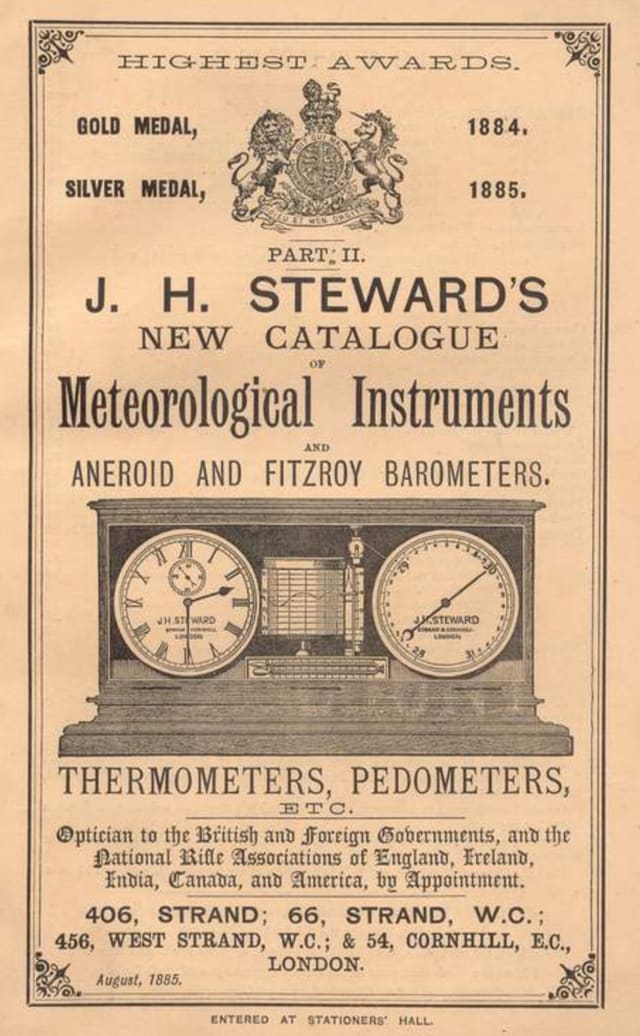
The cover of the 1885 catalogue reads like a manifesto: the royal arms, "HIGHEST AWARDS", four London addresses one after another, and a title of breathtaking ambition — "Optician to the British and Foreign Governments, and the National Rifle Associations of England, Ireland, India, Canada, and America, by Appointment". Below it, an engraving of a desk weather station: a clock on the left, a recording barograph in the middle, an aneroid on the right, and the same signature on every dial — J. H. Steward.
Behind all that splendour stands a man who in 1851 described himself as a silversmith, and who began by selling pocket watches from a stall at rifle meetings. The firm he founded lasted one hundred and twenty-three years, four generations and five reigns. It supplied instruments to British officers, to the champions of Wimbledon and Bisley, to mountaineers and to railway timekeepers — and then closed quietly in 1975 in the seaside town of Hove, a hundred miles from the Strand.
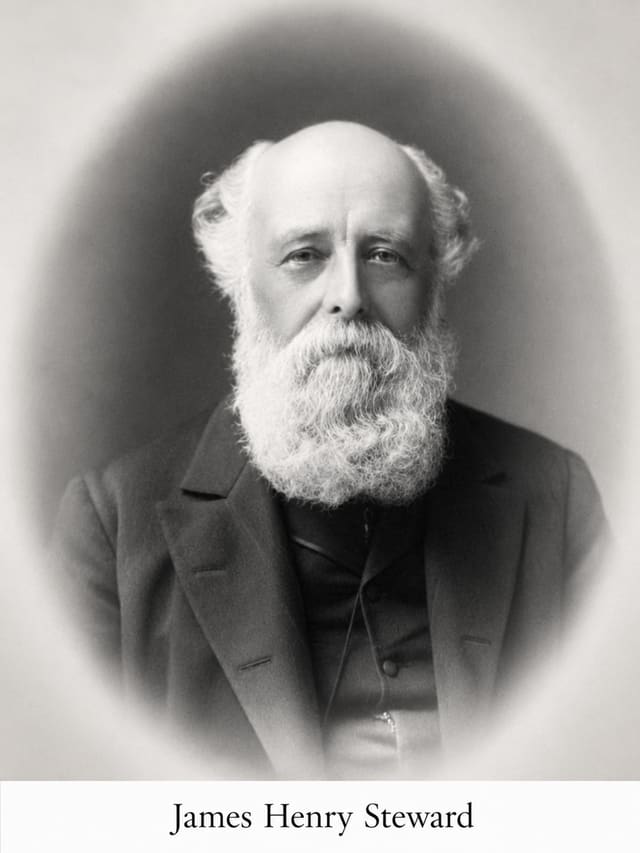
James Henry Steward was born in London in 1817. By the middle of the century he was working in silver — that is exactly how he described himself, silversmith, in the records of 1851. A year later, in 1852, he set up on his own account, and by the Post Office London Directory of 1853 an address appears that would become legendary: 406 Strand.
The early trade was modest and thoroughly practical: pocket watches and field-sports equipment, sold partly from a stall at shooting matches. In the directory of 1861 Steward is listed as a "watchmaker, jeweller and optician" — three trades in a single line: precision mechanics, precious metal, and glass. From that combination grew everything that followed, a business whose catalogue could set a barometer beside an opera glass, and a stopwatch beside a rifle-sight adjuster.
Steward married Aquila Knight; between the 1850s and 1860s the couple had six children — four sons and two daughters. All four sons eventually entered the business. The founder himself died on 28 August 1896, having lived to see his name engraved on instruments in London, Calcutta and Ottawa.
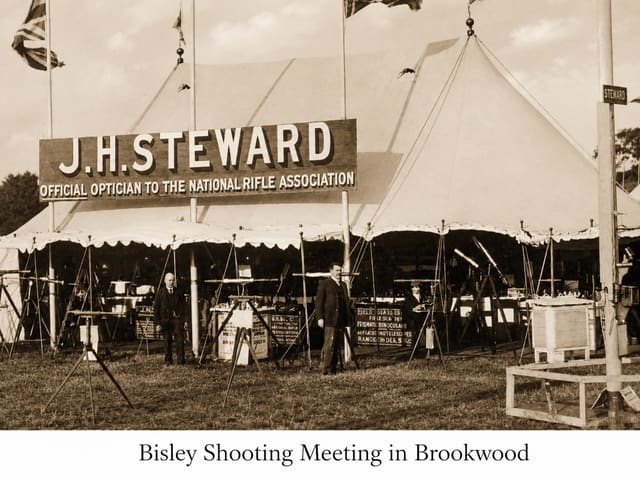
The firm's fortunes were decided by the rise of Britain's volunteer shooting movement. The National Rifle Association was founded on 16 November 1859, and from 1860 its Imperial Meeting was held on Wimbledon Common — on the very ground later given over to tennis. The thousands of volunteer marksmen who gathered there all needed the same thing: good optics. Sight adjusters, spotting telescopes to find a bullet hole at a thousand yards, shooting spectacles, barometers and thermometers — because a serious rifleman allows for air density.
Steward was in exactly the right place. His first advertisement in an NRA programme appeared in 1865, and from 1866 he began styling himself "Official Optician to the National Rifle Association". The title, it must be said, was his own invention: the NRA operated no scheme for accrediting suppliers. The device worked so well that in 1885 it was copied by William Gregory — a long-serving former employee who set up on his own and advertised himself with precisely the same words. Friction between the two "official opticians" ran on until 1910. The second half of the formula on the catalogue cover — "Optician to British and Foreign Governments" — should be read in the same spirit: the language of Victorian advertising rather than a grant of exclusivity.
The connection with the NRA was nonetheless genuine and remarkably long-lived. When the Association received its Royal Charter from Queen Victoria in 1890 and moved its meeting to Bisley in Surrey, the Stewards moved with it. Seven members of the family were granted life membership. From 1902 the firm's own team prize, the Steward Trophy, has been shot for — and still is. And in 1913 John James Steward, the founder's third son, won the Imperial Tobacco Co. Trophy himself with 47 out of 50 at a thousand yards: an optician who shoots as well as his customers is the best advertisement imaginable.
The firm's most celebrated product was the "Lord Bury" telescope, named after Viscount Bury — William Coutts Keppel, later 7th Earl of Albemarle — who edited the NRA's Manual of Rifling and Rifle Sights in 1864 and served as Under-Secretary for War from 1878 to 1880. Steward advertised himself as its Sole Manufacturer.
It was a pancratic instrument of variable power — 25×, 30× and 35× — and the catalogue described it with splendid Victorian precision: it "will show a flagstaff at 22 miles, and show the time by a church clock at 6 miles". Example number 844 was presented to the Belgian volunteers visiting Wimbledon in July 1866, inscribed in French: "Presenté à Messieurs les Volontaires Belges… Par J.H. Steward. Opticien de l'Association du Tir National de l'Angleterre".
The telescope outlived its patron. Alongside instruments by Ross, the Lord Bury served British snipers and observers as a stalking and observation telescope right up to the First World War.
From the late 1860s Steward did something almost provocative for a Victorian shopkeeper: he opened branch after branch, all within walking distance of one another. By the mid-1880s four addresses appeared side by side on the printed catalogue cover.
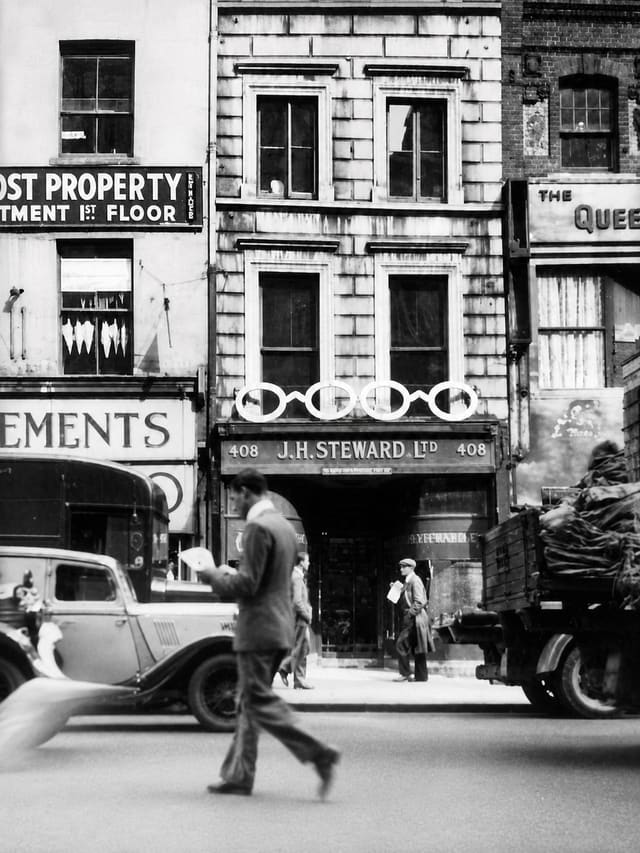
The sequence runs as follows. The flagship was always 406 Strand — from the mid-1850s and, as it turned out, until 1971. In 1866–67 came a City shop at 54 Cornhill, which lasted into the early 1890s. In 1867 the firm added 63 St Paul's Churchyard, in the shadow of the cathedral; it outlived most of the others, surviving to around 1930. In 1869 came 66 Strand; in the late 1870s 456, and then 457 West Strand, close to Trafalgar Square. In 1893 a shop opened at 7 Gracechurch Street.
The logic of this geography was familial: each son, on coming of age, was given a shop of his own to run. James Henry Charles (1859–1900), Henry William Lake (1861–1936), John James (1862–1946) and William Jesse (1864–1924) all entered the trade, and all four were needed to hold the network together.
Buildings, of course, set their own terms. In 1928, when the block containing 457 West Strand was scheduled for demolition, the branch was simply wound up and folded back into the head office. By then the firm had a different character altogether.
The Steward range is hard to sum up in a word, and that is perhaps its defining feature. The firm issued a whole series of illustrated catalogues divided into thematic sections — military instruments, surveying and drawing, mathematical appliances, meteorology. By the turn of the century there were around nine of them.
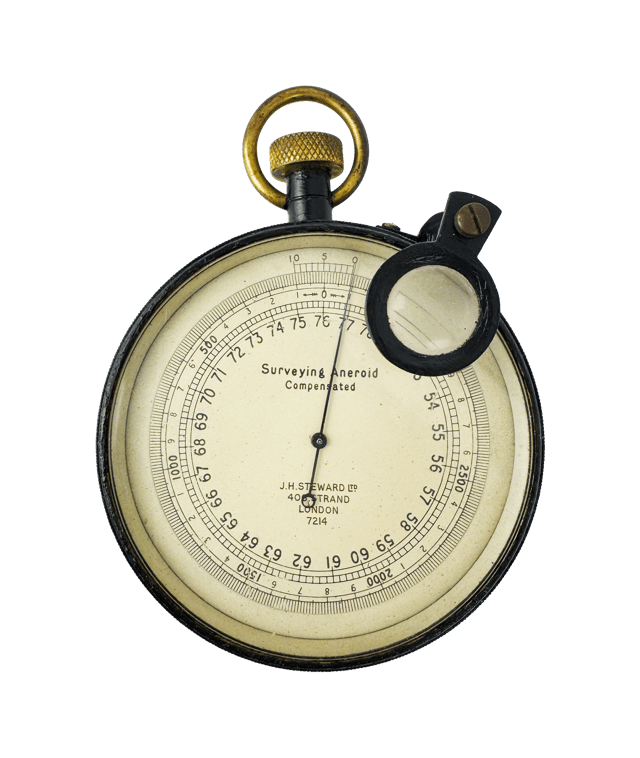
Meteorology was the heart of the 1885 catalogue. Aneroids of every kind — pocket, compensated, fitted with altitude scales for mountaineers and balloonists; Fitzroy barometers, which the catalogue recommended as being in use at all railway termini and the principal hotels in London; mercury barometers, thermometers, hygrometers, and passometers. The star of the section was "J.H. Steward's Improved Hourly Self-Recording Aneroid Barometer" — the very station shown on the cover, with clock, recorder and aneroid combined in a single mahogany case. One curious hybrid also survives: a glycerine barometer by James B. Jordan, modified in Steward's workshops in June 1886 and now in the Science Museum. A typical pocket altimeter of the firm — number 5562, of about 1887 — carried a scale from 21 to 31 inches of mercury and an altitude scale from zero to ten thousand feet, marked "Compensated, Temp Alt Scale 50° Faht".
Optics meant telescopes and spyglasses, field and opera glasses (the "Tourist" model still turns up regularly), and microscopes of every class: student drum models, compound achromatics, dissecting instruments, and a folding portable microscope of the firm's own design. The labels on early examples carry an address touchingly practical in its specificity: "J.H. Steward, Optician & Microscope Maker, 406 Strand, near the Adelphi Theatre" — next to the theatre, so the customer would not get lost.
Military work was a separate and highly profitable branch. The military catalogue included the Verner pattern service prismatic compass, sketching boards, the cavalry sketching board, telemeters, and instruments "for reconnoitring, sketching, night marching, signalling and gun laying". These went through the colonial campaigns, the Boer War and the First World War; Steward binoculars even turn up with US Navy markings.
Photography and projection brought magic lanterns (the "Premier" projector), lantern slides, graphoscopes, and microphotographs on glass produced by John Benjamin Dancer's process and published under the imprint "published by J H Steward, Optician, Near The Adelphi Theatre, 406 Strand".
Surveying, drawing and physics covered theodolites, compasses, drawing and mathematical sets, and goniometers. One Steward reflecting goniometer served Kathleen Lonsdale at University College London, later one of the first women elected to the Royal Society. Slide rules Steward sold were other people's — Tavernier-Gravet, Nestler, Faber — the firm reserving design work for a few special models only.
And finally timekeeping, where it all began. A Steward stopwatch was used by the Rev. W. J. Scott and Charles Rous-Marten of The Railway Magazine on 9 May 1904 to time the Great Western Railway locomotive No. 3440 "City of Truro" down Wellington Bank. The quarter mile between posts went by in 8.8 seconds — 102.3 miles per hour, the first hundred ever claimed for a steam locomotive. All that survives of the record is the sweep of a hand across a dial signed by a London optician. In 1907 the firm introduced a sun chronometer to Ferguson's design, an example of which was presented to the Science Museum in 1912.
The answer is both, and it matters to anyone holding a Steward instrument. Some products the firm genuinely designed and built in its own workshops: the Lord Bury telescopes, compasses, military instruments, improvements to binoculars. But the catalogues make no secret of the fact that a great deal was bought in from outside makers and sold under the Steward name. The Smithsonian puts it plainly of one pocket aneroid: Steward sold the instrument, but probably did not make it. Aneroids almost certainly came from specialist French and English workshops, and recording movements from firms such as Casella or Negretti & Zambra.
By the early twentieth century the balance had tilted towards retail. Limited manufacturing continued into the 1920s; by 1930 the workshops had closed and Steward had become, in the main, an international retailer — though with a name that still carried weight.
The family's inventive period fell around the turn of the century and amounted to nine British patents.
The founder began: in 1895, GB189412309, "Improvements in Distance Measuring Instruments or Telemeters". Then, with A. J. Wilson, GB189507638 (1896) on improvements in rifle-sight adjusters. Three followed in 1897: GB189605563, magnetic compasses for night marching and course indicating; GB189609204, improvements in binocular field and opera glasses; and GB189709492, with W. J. Bosworth, on sketching boards and map-supporting frames. In 1899 came GB189906962, binoculars and telescopes again.
The sons then took over. Henry William Lake and John James Steward obtained GB190207887 (1903) for cases for carrying binocular field glasses, GB190327429 (1904) for sketching instruments, and finally GB191107500 (1911) — "An Improved Recording Aneroid Barometer". The circle closed: the family's last patent returned to precisely where the meteorological catalogue of 1885 had begun.
On 1 February 1913 the family business was incorporated as J. H. Steward Limited. The "Ltd" on a dial is a convenient boundary: anything carrying it was made after that date.
The First World War brought work — the British army was desperately short of optics, and Steward binoculars found their way into the hands of a great many officers. But the post-war decade, and then the depression of the 1930s, told against the firm. The shops closed one by one until a single one remained: 406 Strand, whose freehold the firm had by then bought outright. From the mid-1930s the business was run by the founder's grandsons, the sons of William Jesse: James Henry junior (1901–1980) and William Malcolm (1903–1970).
In April 1970 William Malcolm died suddenly. His elder brother's health was already failing, and management passed to the founder's great-great-grandson, David Michael Steward, and his wife Theodora.
In 1971 the premises at 406 Strand were sold, after some hundred and fifteen years under the Steward name. What remained of the stock — and the single remaining employee, the dispensing optician George Goble, who had spent decades with the firm — moved round the corner to Catherine Street. In 1973 the instrument side moved down to Hove on the Sussex coast, and in 1975 the firm closed for good.
It went, to its credit, tidily. The surviving collection was divided between three museums: the Science Museum in South Kensington, the National Maritime Museum at Greenwich, and the Whipple Museum in Cambridge, which bought an entire "J H Steward Collection" from the family in 1973. The Science Museum archive holds the firm's papers for 1893–1939: catalogues, instruction sheets, correspondence, patents, drawings and photographs.
The name found a home too. As early as 1972 George Goble arranged for the brand to pass to his niece Elizabeth and her husband Simon Goldsmith, who founded J.H. Steward (Bisley) Ltd — a company that still supplies shooting optics today under the name JHS Eyewear. The circle that opened on a stall at Wimbledon in the 1860s closed at Bisley, on the same ground it had been drawn. The company itself, with its goodwill, was sold by David Michael Steward in 1975 to the Suffolk firm Newbold & Bulford, trading as Enbeeco.
The history of J. H. Steward is the history of a well-chosen moment, held for an extraordinarily long time. A silversmith who opened a shop on the Strand seven years before the National Rifle Association was founded ended up as supplier to an entire national movement; a title he awarded himself worked for the firm for half a century; his sons turned one shop into a chain, and his grandsons honestly wound it back to one when the times required it.
For the collector there is a practical conclusion in all this. A Steward mark is less a maker's signature than an address and a date. The list of addresses on a dial narrows the dating to a decade: "63 St Paul's Churchyard, 406 & 66 Strand & 54 Cornhill" points to the late 1860s through the 1880s; "406 & 457 West Strand" to 1886 onward; "J.H. Steward Ltd, 406 Strand" to after February 1913. The question of who actually made the case and the aneroid capsule usually remains a separate one — and it is more honest to write "retailed by J. H. Steward" until evidence says otherwise.
The firm lived from the age of the muzzle-loading rifle to the age of the communications satellite. Instruments sold in a house opposite the Adelphi Theatre are still reading the pressure — and, if the catalogue is to be believed, still telling the time on a church clock six miles away.
David G. Rance, "J. H. Steward: A Family Dynasty", Slide Rule Gazette, Issue 12 (2011, revised 2018). The single most detailed study of the firm, based on correspondence with the founder's great-great-grandson David M. Steward and on the Whipple Museum's J H Steward Collection. Source for the chronology of addresses, the family tree, the list of nine patents, the self-awarded NRA title and the Gregory rivalry, and the closing years. — https://sliderules.nl/media/papers/Gazette_12_-_J_H_Steward_V2.pdf
Science Museum Group Collection — J H Steward Limited. Institutional biography: dates of the founder, foundation in 1852, incorporation on 1 February 1913. — https://collection.sciencemuseumgroup.org.uk/people/ap24819/j-h-steward-limited
Science Museum Group — objects by J H Steward. Instruments held, including the Jordan glycerine barometer modified by Steward in 1886, student microscopes, the W. J. Scott stopwatch and the Ferguson sun chronometer. — https://collection.sciencemuseumgroup.org.uk/search/objects/makers/J%20H%20Steward
Science Museum Group Archives — Papers of J. H. Steward Ltd, 1893–1939. Catalogues, instruction sheets, correspondence, patents, drawings, photographs. — http://archives.sciencemuseumgroup.ac.uk/Details/archivescience/110066868
Science Museum Group — student microscope by J.H. Steward, 406 Strand. Label wording and dating. — https://collection.sciencemuseumgroup.org.uk/objects/co118754/student-microscope-by-j-h-steward-406-strand-lo-student-microscopes
Grace's Guide to British Industrial History — J. H. Steward. Key milestones: 1852 foundation, the 1900 R. H. Smith calculator, the 1907 sun chronometer, the 1912 Science Museum gift, incorporation, and the final years. Cites The Engineer (1900) and The Aeroplane Directory (1937). — https://www.gracesguide.co.uk/J._H._Steward
Edwin Banfield, Barometer Makers and Retailers 1660–1900, cited through dealer records: 406 Strand 1857–1900; 67 Strand 1867–68; 54 Cornhill 1867–92; 66 Strand 1869–88; 456 Strand 1879–88; 457 West Strand 1886–1900; 7 Gracechurch Street 1893–1900. — https://www.oldetimeantiqueclocks.co.uk/clock/pocket-barometer-by-j-steward-london/
Stichting voor Historische Microscopie — Steward. The 1851 "silversmith" description, the 1853 Post Office Directory entry for 406 Strand, the early watch and sporting-goods trade, and the self-awarded appointments. — http://stichtinghistorischemicroscopie.nl/en/category/steward-en/
Barometers Realm (barometers.info) — J. H. Steward. Brand entry and catalogue references; the starting point of this research. — https://barometers.info/brands/jh_steward
Smithsonian National Museum of American History — aneroid barometer by J. H. Steward Ltd. Explicit statement that Steward sold but probably did not make the instrument; shop opening dates. — https://americanhistory.si.edu/collections/search/object/nmah_1184565
Powerhouse Museum Collection (Sydney). Steward aneroid and dissecting microscope; notes on the firm's government and NRA connections, citing Banfield and Julian Holland, Bulletin of the Scientific Instrument Society, No. 61 (1999). — https://collection.powerhouse.com.au
earlyphotography.co.uk — camera makers and companies. Genealogical dates for the founder and his four sons, and the marriage to Aquila Knight. — http://www.earlyphotography.co.uk/site/companies4.html
Hagley Digital Archives — "J.H. Steward's New Catalogue of Optical, Philosophical, Mathematical, Surveying, and Meteorological Instruments". Digitised primary catalogue. — https://digital.hagley.org/08062028_j_h_steward
Compass Library — J. H. Steward's Catalogue of Military Instruments (1909). Contents of the military range: Verner compasses, sketching boards, telemeters, night-marching instruments. — https://www.compasslibrary.com/en-us/products/j-h-stewards-catalogue-of-military-instruments-1909
Van Leest Antiques — Lord Bury telescope by J. H. Steward. Powers, catalogue description, and the 1866 Belgian volunteers inscription. — https://www.vanleestantiques.com/product/lord-bury-telescope-made-by-j-h-steward/
Worcester Antiques — history of British military sniping and observation telescopes. Use of the Lord Bury by snipers and observers up to the First World War. — https://www.worcesterantiques.co.uk/blog/history-of-british-military-sniping-telescopes.htm
WorldCat — Manual of Rifling and Rifle Sights, edited by Lieut.-Col. Viscount Bury MP for the National Rifle Association (1864). Establishes Bury's role in the NRA. — https://www.worldcat.org/title/manual-of-rifling-and-rifle-sights-edited-by-lieut-col-viscount-bury-mp-for-the-national-rifle-association/oclc/559859300
microscope-antiques.com — Steward's New (Folding) Portable Microscope. Design and labelling of the firm's portable microscope. — https://microscope-antiques.com/stewardfolding.html
Antilles Trading Company — J. H. Steward brass student microscope, c. 1900. Label wording, "near the Adelphi Theatre". — https://antillestradingcompany.com/1900s-vintage-j-h-steward-brass-barrel-student-microscope-w-slides-and-lenses/
Selling Antiques — J. H. Steward, Strand, pocket barometer. Dial markings and dating of pocket aneroids. — https://www.sellingantiques.co.uk/458170/j-h-steward-strand-pocket-barometer
1stDibs — J. H. Steward Ltd field glasses, c. 1920. Post-incorporation markings. — https://www.1stdibs.com/furniture/decorative-objects/desk-accessories/more-desk-accessories/english-working-binoculars-field-glasses-jh-steward-ltd-circa-1920/id-f_20674892/
LiveAuctioneers — brass binoculars, J. H. Steward, 406 Strand. Address-based dating of optical goods. — https://www.liveauctioneers.com/item/1968750_english-brass-binoculars-jh-steward-406-strand
The Great War Forum — J. H. Steward "The Tourist" binoculars with US Navy marking. Wartime distribution of the firm's binoculars. — https://www.greatwarforum.org/topic/283026-jh-steward-the-tourist-binoculars-with-us-navy-marking/
Whipple Museum of the History of Science, Cambridge. The J H Steward Collection, purchased from the family in 1973. — https://www.whipplemuseum.cam.ac.uk
The National Archives, Discovery catalogue. Record of surviving company papers. — https://discovery.nationalarchives.gov.uk