Loading
Gebrüder Winter OHG was founded on 1 October 1931 in Jungingen (the historic region of Hohenzollern, now Baden-Württemberg, Germany) by three brothers – Eugen, Heinrich, and Willy Winter. From the very beginning, the firm specialised in the development and production of meteorological instruments, primarily barometers and devices for measuring atmospheric parameters.
In 1935 the brothers purchased a building on the Hauptstraße, the main street of Jungingen, for their factory – a facility that was later expanded several times. The company quickly established itself in the market for precision instruments. By the mid-1930s, in addition to meteorological devices, the Winter brothers began developing on-board aviation instruments – then a new field, as sport aviation was only emerging. According to tradition, aviation pioneers Martin Schempp and Wolf Hirth (founders of Schempp-Hirth) approached the Winter brothers saying: “Anyone who can make barometers can make altimeters,” which defined the direction of production expansion. By the late 1930s, Gebr. Winter was already known as a specialised manufacturer of precision mechanical aviation instruments alongside its meteorological line.
Product Range and Specialisation
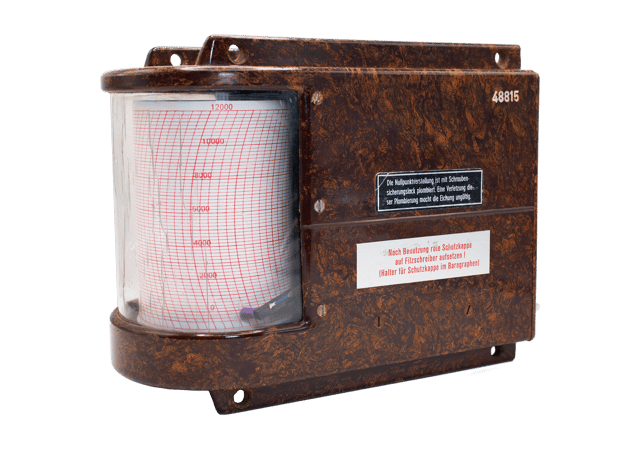
In the pre-war period the company primarily produced aneroid barometers (for household and professional use) and meteorological recorders (meteorographs). As aviation progressed, a significant portion of production shifted to aircraft instruments: altimeters, airspeed indicators, etc. Already before World War II, many German gliders and light aircraft were equipped with Gebr. Winter instruments. The accumulated experience, high-quality workmanship, and reliability of the products earned the company a strong reputation in aviation circles.
World War II (1939–1945)
During World War II, like many German instrument manufacturers, Gebr. Winter was integrated into the wartime economy. The company produced aviation altimeters and barographs for the Luftwaffe. Among them were altitude recorders (Höhenschreiber) – barographic devices used in military aviation to register flight altitude – manufactured in Jungingen. Despite the military involvement, the company remained a family business: there is no evidence of forced nationalisation or relocation during the war. The factory continued to operate in Jungingen without major destruction and retained its technical base and personnel through to the end of the war.
Post-War Development and Technical Direction
After 1945, Germany faced restrictions on aviation, but as sport and recreational flying revived in the early 1950s, Gebr. Winter regained its market. The company reoriented production entirely toward aviation instruments. The manufacture of meteorological equipment for general use became secondary to aircraft instrument production.
By the mid-20th century, the factory had fully established itself as a specialist in mechanical onboard flight instruments. The main products manufactured from the 1950s onwards included:
Administratively the company maintained family succession: after the war, management passed to Heinrich Winter’s sons — the second generation. Its legal status evolved from OHG to Gebr. Winter GmbH & Co. KG, still retaining the historical name. Production remained on Hauptstraße in Jungingen and saw continuous expansion and modernisation during the 1950s–60s.
Although Winter instruments became globally distributed, production remained artisanal: each unit was built and calibrated manually by a single master. No conveyor manufacturing is used — the firm preserves traditions of fine precision mechanics. Even in the era of digital avionics, Winter’s mechanical altimeters and variometers remain valued by pilots as reliable, power-independent backup instruments.
Modern Era and Legacy
Today, Gebr. Winter GmbH & Co. KG continues to operate as a family-run enterprise now led by the third generation. By 2021, the firm celebrated its 90-year anniversary. Its director, Gerd Winter, succeeded his cousin Achim Winter, who retired in 2020.
The Jungingen plant employs roughly 13–16 skilled craftsmen who assemble around 1800 new instruments each year and service another ~1500 older units. Production remains strictly mechanical, built on differential pressure measurement without electronics. Components are either manufactured in-house or supplied by German and Swiss precision workshops, maintaining independence and quality.
Winter instruments are regarded worldwide — especially in gliding — for precision, longevity, and reliability. As Achim Winter once noted: “Among glider pilots, the name Winter is known like Coca-Cola among soft drinks.”
The company carefully preserves its heritage. Early Winter barometers and aviation recorders survive in museum and private collections, and the factory maintains archival registers of all instruments produced since the 1930s. When possible, Winter continues to service and calibrate even early-generation equipment. A small historical display exists within the factory, and occasional public tours are held — for example, in 2015 when ~50 vintage Bücker aircraft pilots visited as part of an aviation rally.
Brand continuity remains important. The historical trademark featured stylised “W” lettering and the inscription Gebr. Winter (Jungingen). Today’s corporate brand Winter Instruments uses a refreshed blue-white design, where the dot over the i is stylised as a flight instrument indicator — linking past and present in one visual symbol.
Current status: Gebr. Winter of Jungingen operates successfully to this day and remains one of the global leaders in the niche of mechanical aviation instruments for light aircraft and gliders. The plant stands as both a functioning workshop and a living museum of mechanical engineering, where each instrument is still built and calibrated by hand, carrying forward an unbroken legacy of nearly a century.
Sources
Historical information derived from regional press (special 90-year company anniversary edition), official publications by Winter Instruments, and specialist aviation sources. References note Winter’s participation in the production of Luftwaffe altitude recorders (Höhenschreiber) — see aeroantique.com — and confirm the brand’s global recognition among glider pilots. Official company website: https://www.winter-instruments.de
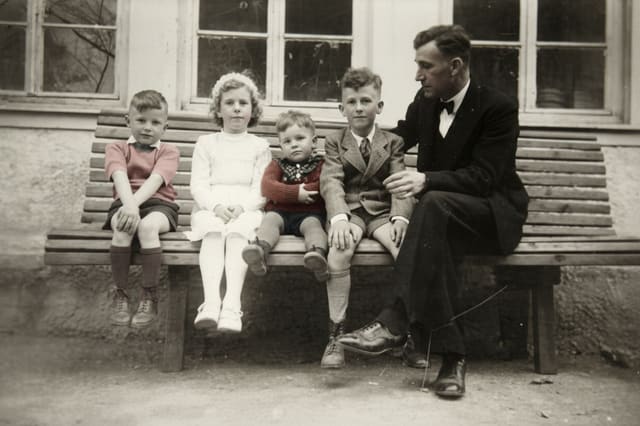
In the photograph are Heinrich Winter with his sons — Hans, Helmut, and Edwin Winter, all of whom later led the company as the second generation — and with his daughter, Franziska.