Loading
G. Bogia & Co. and the Bogia Family: A Documented History and Reconstruction of a Craft Dynasty
Italian Origins and the Causes of Emigration
The history of the Bogia family begins in Northern Italy—almost certainly in the Lake Como region of Lombardy, which in the eighteenth century functioned as one of the principal “incubators” of European scientific instrument makers. It was from this region that dozens of known barometer makers emerged, and it was here that a distinctive craft culture developed, based on the transmission of technical knowledge within families.
The causes of emigration were not cultural but economic. The region suffered from overpopulation and limited resources; agriculture could sustain families for only part of the year, forcing inhabitants to seek supplementary income. As a result, a stable economic model emerged in which instruments—barometers, thermometers, and optical devices—were manufactured during the winter months, while the summer season was devoted to itinerant trade across Europe. These individuals were not merely merchants; they were both makers and sellers of their own products.
By the eighteenth century this had developed into a structured migratory system. Young men left Italy, often following relatives already established abroad, and set up small workshops or trading operations in foreign cities. It is within this broader context that the appearance of the Bogia family in the Netherlands must be understood.
Franciscus Bogia: The First Documented Generation
The key figure is Franciscus Bogia (Boggia), recorded in Leiden in 1779. According to the research of Maria Rooseboom, based on an advertisement in the Leydse Courant (28 April 1779), he is described as: “Mr. Weerglasmaker” and retailer of scientific instruments, who settled in Leiden in 1779. Former apprentice of Joseph Tessa.
This description is of particular importance. The term Weerglasmaker, literally “maker of weather glasses,” refers specifically to a barometer maker. It denotes not a general craftsman but a specialist in atmospheric instruments, reflecting the early Dutch conception of the barometer as a glass device indicating weather conditions.
Franciscus Bogia thus emerges as a professionally trained barometer maker who also traded in scientific instruments and arrived in the Netherlands already possessing technical expertise. His apprenticeship under Joseph Tessa is especially significant, pointing to the Italian system of craft transmission within networks of masters, often originating from the same region.
In May 1779 he took up residence with J. Meysingh, a corset maker (rijglijfmaker), in the Diefsteeg area at the corner of the Lange Brug in Leiden. This arrangement is consistent with the broader pattern of Italian craftsmen settling in mixed artisanal districts, where different trades coexisted and supported one another.
Material Evidence: Surviving Instruments by Franciscus Bogia
The existence of Franciscus Bogia as an active maker is not based solely on archival references but is firmly supported by surviving objects.
At least two documented instruments can be directly attributed to him. The first is a walnut bakbarometer formerly in the stock of the Dutch dealer LePipe Antiek, signed “F. Bogia tot Leyden”, approximately 115 cm in height and fitted with silvered pewter scale plates. The second is a Dutch barometer of the Louis XVI period sold through Christie’s, signed “F. Boggia / Leijden”, with a height of approximately 118 cm.
These objects are of central importance. They provide tangible confirmation of the maker’s activity, demonstrate his engagement with the bakbarometer form, establish the Leiden attribution, and document the orthographic variation of the surname (Bogia/Boggia). Together, they form the primary evidential basis for reconstructing the early phase of the Bogia workshop.
The Italian Craft Network in the Netherlands
During the second half of the eighteenth century, the Netherlands saw a notable influx of Italian craftsmen. These individuals worked as glassblowers, barometer makers, scale engravers, and case manufacturers. Their migration routes typically led across the Alps into Switzerland, then along the Rhine into Dutch cities such as Amsterdam, Leiden, Rotterdam, and Haarlem.
Italian names appear on barometers throughout the country, confirming the existence of a stable diaspora and professional network. A defining feature of this environment was the familial transmission of craft knowledge: skills were passed from father to son, as well as to brothers, nephews, and cousins, and workshops frequently formed, dissolved, or recombined along family lines.
The Transition to G. Bogia & Co.: The Second Generation
Against this background, G. Bogia & Co. emerges as the next stage in the development of the family enterprise.
Although direct archival references to G. Bogia are scarce, the figure can be confidently reconstructed as a relative—most likely a son or nephew—of Franciscus Bogia, who inherited the craft and continued production into the late eighteenth and early nineteenth centuries. The pattern follows a typical Italian family trajectory: the first generation arrives as a trained artisan, establishes itself locally, and combines manufacture with trade, while the second generation, formed within the host country, continues the craft while adapting it to local market conditions.
Franciscus Bogia, active from 1779, produced bakbarometers and operated as both maker and retailer. The subsequent generation, represented by G. Bogia, appears to have been active roughly between the 1790s and 1820s, maintaining the technical tradition while shifting the product range.
From Bakbarometer to Stick Barometer
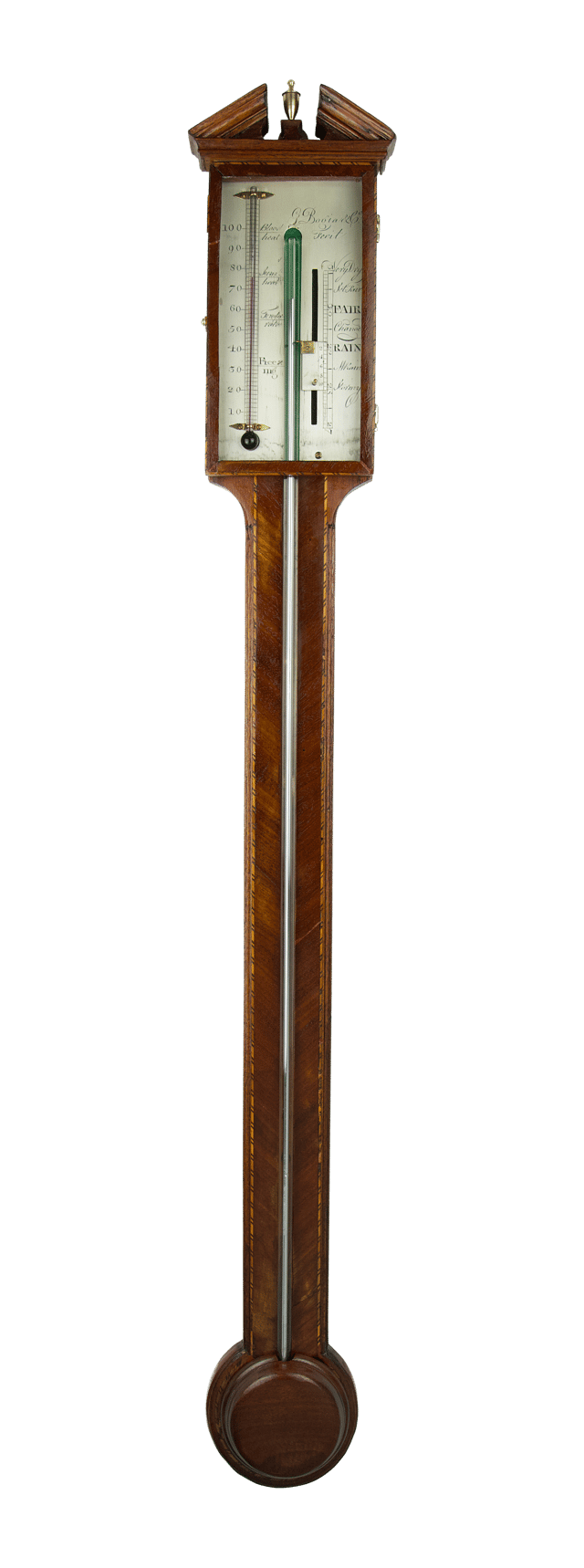
The transition from the bakbarometer to the stick barometer represents a significant shift, both economically and technologically. Early works associated with the Bogia name belong to the more complex and decorative bakbarometer type, while later production reflects a move toward the simpler, more commercially viable stick barometer.
This transition mirrors a broader trend of the period: a movement away from elaborate, highly individualised constructions toward more standardised and reproducible instruments. Importantly, however, the underlying Italian glassmaking tradition did not disappear. It remained embedded in the quality and construction of the barometric tubes and reservoirs, preserving a key element of the family’s technical heritage.
A confirmed barometer signed G. Bogia & Co. is today preserved in the collection of the Art of Weather Instruments Foundation, providing direct material evidence of this later phase.
The addition of “& Co.” is a significant indicator of organisational change. It suggests that the workshop had expanded beyond a single craftsman to include either family members, business partners, or hired workers. For Italian émigré artisans, this represents a typical stage of development, marking the transition from individual practice to a small-scale commercial enterprise.
The Surname Bogia / Boggia: Orthographic Variability
In the limited sources available, the surname appears in multiple forms—Bogia and Boggia. This variation is entirely consistent with eighteenth-century practice. The absence of standardised spelling, phonetic adaptation into Dutch, clerical recording errors, and deliberate simplification for commercial purposes all contributed to such differences. These variations do not indicate separate families but rather different recorded forms of the same name.
Information on the Bogia family remains extremely limited. In his study of the contra-bakbarometer, Anton Fontaine explicitly notes that F. Boggia of Leiden is not mentioned in standard works on barometers. This observation is crucial, as it explains the near absence of the name from secondary literature. The maker is known primarily through surviving objects and museum records rather than through contemporary publications or later historiography. His name persists in collection catalogues, archival cards, and auction descriptions, but did not enter the canonical literature—a common fate for Italian craftsmen, who left instruments rather than written records.
A separate Amsterdam branch of the Bogia family is known, associated with the production of plaster objects and documented through archival records and surviving works. This branch is likewise traced to the Lake Como region.
No direct documentary evidence links the Amsterdam and Leiden branches. However, the coincidence of surname, geographic origin, migration period, and the well-established pattern of family-based migration strongly suggests a probable familial connection. Such parallel branches are typical within Italian émigré communities, where different members of a wider family network established themselves in different cities and trades.
Conclusion
The history of G. Bogia & Co. represents a rare but characteristic example of an Italian craft dynasty integrated into the scientific and commercial culture of Northern Europe. Its roots lie in the economically constrained yet technically skilled environment of Lombardy; its migration was both necessary and systematic; its first documented representative, Franciscus Bogia, appears in Leiden in 1779 as a professional barometer maker; and its subsequent generation, represented by G. Bogia, continued and adapted the craft, moving toward more standardised production while preserving core elements of Italian glassworking tradition. The addition of “& Co.” marks the transition to a stable workshop structure. Far from being an isolated figure, Bogia was part of a broader transnational network that played a decisive role in the dissemination of barometers across Europe.
Sources:
Primary archival and institutional sources
Object-based (material culture) sources
Scholarly and analytical references
Contextual and historical framework (Italian migration and craft tradition)
Supplementary contextual sources