
Loading
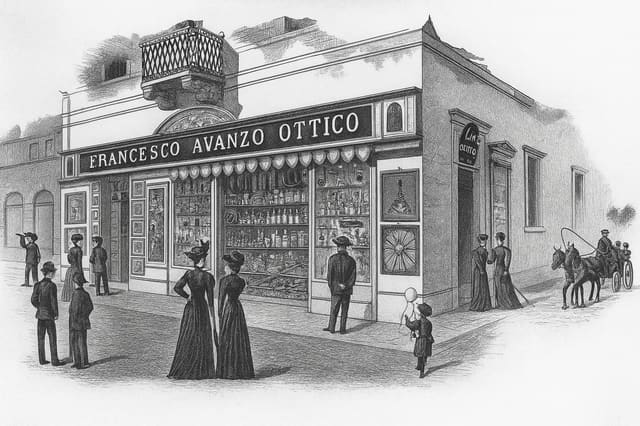
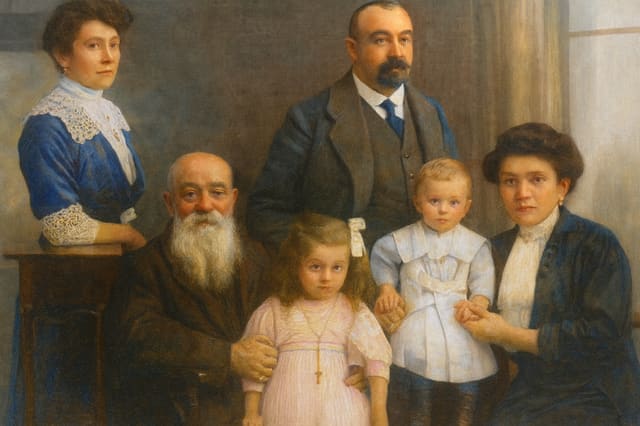
Francesco Avanzo (1836–1914) was a distinguished optician and entrepreneur of the late nineteenth and early twentieth centuries who founded his own optical-goods shop in the city of Trento. The Avanzo family came from the mountainous area of Pieve Tesino in Trentino, known for its traditions of itinerant trade.
The Tesini
At the head of the Valsugana valley in the province of Trento, at an altitude of roughly 900 meters, there are three small villages surrounded by meadows and pastures, mountains and forests. These are Pieve Tesino, Cinte, and Castello Tesino, halfway between Trento and Bassano del Grappa, with about 3,500 inhabitants who are called the “Tesini.”
Encircled by mountains rich in forests but poor in arable land—short summers did not always allow grain to ripen fully—Tesino had long lived by pastoralism. Yet this activity could not always guarantee steady support for families, and so as early as the seventeenth century the inhabitants began selling flints for flintlock rifles, quarried from local pits where the stone was plentiful. Leopold II of Austria granted the Tesini the right to peddle flints throughout the territory, and this privilege was confirmed by a decree of May 10, 1700. Thus the traders of Tesino began to travel across Europe with heavy boxes of flints on their shoulders. Germany, Poland, and Hungary were their most frequent destinations—distant lands requiring many days of travel, often on foot.
Itinerant trade came to characterize the history of the people of Tesino, who for more than two hundred years left their valley “with a box on their back” (cassella), first to sell the flints—so abundant in the area—used in the locks of matchlock and flintlock muskets of foreign armies, and later (by the nineteenth century) to sell prints. In Bassano del Grappa the Remondini printing house emerged, quickly becoming renowned in this field. It was there that the Tesini purchased oleographic reproductions, on various grades of more or less costly paper, to resell them across Europe: from east to west, even reaching Mexico. These traders, who traveled as much as possible on foot, were also called pertecanzi. Prussia, France, Spain, the Netherlands, the Americas, Asia, Australia, and Russia—these are only some of the many places these men reached, overcoming dangers and foul weather. A phenomenon unique in Europe.
Thus, itinerant trade in printed images became one of the principal forms of activity for the Tesini. Over time, and with growing experience, the Tesini developed considerable skills not only in commerce but also in artistic and cultural fields. Frequently, for organizational reasons, the heads of trading “companies” set up depots for their goods throughout Europe; when circumstances allowed, these depots gradually turned into real shops, first under company names and later under individual family names.
The shops did not replace the activity of the girovago (the itinerant peddler), which continued for all those who were unable to open a true shop, and even for shop owners themselves, who never refused to embark on long journeys to sell their wares.
The Tesini trading enterprises became a point of attraction for all the young people of the valley who were looking for work, and soon small Tesini communities sprang up around the shops scattered across Europe—communities that never ceased to maintain ties with their native valley.
Thus, the Veneto region—from Trento to Trieste—had already become known in the nineteenth century for crafts related to optics and photography. The well-known optician Francesco Avanzo owned a large optical shop in Trento. His son Gerardo also took up the trade, opening a shop in Bolzano in 1893. And one of the grandsons by marriage, Ettore (also an Avanzo, but from another branch of the family), owned his own shop in the 1930s in Milan.
In Pieve Tesino, to distinguish between families from different branches who share the same surname, a second (and sometimes even a third) family name is used and added to the first. Thus Francesco Avanzo (1836–1914) belonged to the branch Avanzo Marchi delle Giole. This branch began with him—Francesco, son of Giacomo and Domenica Buffa of Pieve—who married Clementina Pastorini (1838–1902), daughter of Felice and Vittoria Romanese.
The Shop of Francesco Avanzo
Francesco Avanzo’s optical shop in Trento offered a wide range of goods: besides eyeglasses and corrective lenses of his own manufacture, it sold spyglasses, binoculars, barometers, compasses, cameras, and other technological novelties of the day. Avanzo himself was a skilled master optician and made glasses to order, grinding lenses and selecting frames to meet clients’ needs. At the same time, a significant share of his inventory was purchased from leading manufacturers of the Austro-Hungarian Empire and Europe. In the shop windows one could see, for example, photographic products by Agfa and Hauff, as well as optical instruments and cameras by the famous brands Zeiss, Goerz, and Voigtländer, which Francesco Avanzo brought to Trento for sale. Thus, the shop combined its own small-batch production (primarily glasses and minor instruments) with the role of a retailer offering the latest imported optics. Already by the late 1800s Avanzo’s shop had become one of the first in the region where one could buy photographic equipment and precision measuring instruments—a sign of the family’s forward-looking approach to its craft.
Francesco Avanzo’s activity unfolded against a backdrop of complex political and military circumstances. Until 1918 Trento belonged to Austria-Hungary, as a border, Italian-speaking city of Tyrol. The Habsburg authorities maintained a significant military garrison in the region, and from the nineteenth century army topographers closely studied and mapped Trentino’s mountainous landscape to strengthen the borders and plan defense. The accumulated military maps bear witness to the close link between geography and war: as the scholar Yves Lacoste wrote, “geography exists primarily to wage war.” In such an environment, demand for optical and navigational instruments was high: army cartographers and artillerymen required theodolites, rangefinders, binoculars, and other tools. It is likely that Avanzo’s shop supplied some of these instruments to local officers and engineers, acting as an intermediary between military needs and the civilian market.
One indirect confirmation of this is a military-related incident involving the Avanzo family. Francesco’s son Gerardo Avanzo was brought to trial alongside the future national hero Cesare Battisti, accused of participating in a pro-Italian demonstration in Trento at the beginning of the twentieth century, amid rising irredentist sentiments. Gerardo and the other defendants were eventually acquitted, but the very fact of the trial underscores the tension between the Italian population and Austrian authority. Family recollections also preserve an episode of Francesco’s bold patriotism: once he took his daughters to Trento’s main square dressed in the colors of the Italian tricolour—green, white, and red—an open challenge to the Austrian authorities of the city. This display of courage and patriotism made Avanzo a well-known figure in the city (he was called a local notabile, a respected citizen) and likely strengthened Italian clientele’s trust in his business.
After the First World War, Trentino passed to Italy, and the importance of military mountaineering and cartography in the region continued to grow—an historical backdrop that can also be regarded as part of the firm’s context. In 1920, in nearby Val di Fiemme (Predazzo), the Italian authorities founded the Alpine Military School—the oldest institution of its kind in the world. Its base consisted of monumental barracks from the Austrian era, begun in 1913 for the Empire’s mountain infantry (Landesschützen). The school trained military skiers and mountaineers for service at high altitude and operated under the aegis of the Guardia di Finanza corps (Fiamme Gialle). At the same time, the Italian General Staff continued the tradition of cartographic work: new topographical surveys, aerial photography, and the updating of maps of the former Austrian territories were carried out by the Italian artillery and cartographic service. All this supports the fact that optics and cartography went hand in hand, and the Avanzo enterprise moved within the current of these historical processes.
The Avanzo Family: Successors and Expansion
Francesco Avanzo laid the foundations not only for a single shop but for an entire dynasty of opticians. His wife Clementina and their children helped in the business, and the bond with their native Pieve Tesino and its community remained strong. Of Francesco’s seven children, four daughters are particularly known—Silvia, Teodolinda, Vittorina, and Albina—and three sons: Gerardo, Umberto (Tullio Remigio), and Ovidio. The daughters played a remarkable role in the family history: three of them (all but Albina, who remained in Trento) married and moved to St Petersburg at the end of the nineteenth century. There, the Avanzo sons-in-law, the entrepreneurs Giuseppe and Alberto Fietta, opened—following Francesco’s example—their own enterprise: a shop of artists’ materials, fine-arts goods, and photography. Among its clients were Klever, Repin, Albert Benois, and many others from the circles of Grand Duchess Olga Alexandrovna, Elisabeth Feodorovna, and Grand Duke Dmitri Pavlovich.
On one occasion, in 1900, Francesco Avanzo traveled to St Petersburg to visit his daughters and grandchildren who had also settled in Russia. In his honor Dazzario of Pieve organized a banquet for fifty people. On that occasion Francesco compiled a list of all the Tesini who at that time were in Moscow and St Petersburg: about eighty people, recorded on a “parchment” with their given names, surnames, ages, and places of origin.
This episode attests to Francesco’s authority within the Tesino diaspora and to the recognition of his merits in training the younger generation. It is known, for example, that Francesco sought to help young people from Tesino to find their way in trade and crafts: “he was always concerned to set our youth on the right path,” as later noted in a study of Tesino history.
In addition to continuing the line through his daughters, the Avanzo name was made famous by other relatives who settled within the former Austro-Hungarian Empire. One Tesino relative of Francesco, Pietro Avanzo, already in 1876 opened an optical shop in Trieste, the empire’s port city. This Triestine shop became the beginning of an entire network: at its peak the Avanzo family owned four large optical salons—in Trieste, Udine, Vienna, and Fiume (Rijeka). In the early twentieth century the leading role in managing this network was played by representatives of the next generation—Emilio, Giacomo, and Mario Avanzo, all descendants of the family from Pieve Tesino. The Trieste shop, operating under the sign “Ottica Fratelli Avanzo,” was renowned for a wide selection of photographic equipment and optics, as well as for having its own photo-lab service. There, as in Trento, the best foreign brands were sold, and over time the assortment was expanded to include radios and movie cameras—evidence of the family’s desire to keep pace with technological progress. The three Avanzo brothers in Trieste successfully weathered the difficult war years, and after the First World War their enterprise was officially registered with the chamber of commerce as “Fratelli Avanzo – Apparecchi fotografici.” The Trieste shop remained in operation until the mid-twentieth century, closing only in 1946. Another family member, Giacomo Avanzo, in the 1920s became co-owner of another Triestine optics firm (Pietro Stolfa Succ.), which speaks to the family’s broad business expansion.
Even a century later the Avanzo name remains well known in Italy’s optical industry. In Trieste the historic Avanzo shop continued to operate until the 1990s, after which it was acquired by a new family of owners—but they retained the old name in honor of tradition. A similar situation is seen in their native Trento: there, for a long time, another famous optical salon operated—Ottica Gecele, also founded by a Tesino (Sebastiano Gecele) in the early twentieth century. In 2018 Ottica Gecele ceased activity, joining a larger chain, yet it too lasted 71 years, underscoring the contribution of Tesino families to the development of optics in the region. Researchers note that the families Braus (Arco), Buffa (Klagenfurt), Gecele (Trento), and Avanzo (Trieste) became legendary dynasties of opticians whose shops, until very recently, preserved their historical names as a tribute to their founders. In 2022, the Per Via museum in Pieve Tesino mounted the exhibition “Mercanti di luce. Ottici e fotografi tesini tra ’800 e ’900” (“Merchants of Light: Tesino Opticians and Photographers between the 19th and 20th Centuries”), where the achievements of Francesco Avanzo and his fellow countrymen were given special prominence. Thanks to archival discoveries by the local historian Elda Fietta and the family archive of the Galli-Avanzo descendants, the story of this unusual family business was reconstructed and presented in full to a contemporary audience.
The End of the Enterprise and Its Legacy
Despite the broad reach of the family, Francesco Avanzo’s own company in Trento ceased to exist in the early twentieth century. The founder himself died on 21 May 1914, on the eve of the world conflict. Soon after the beginning of the First World War, most of Trento’s Italian inhabitants were evacuated or fled the front-line city, and an optical shop simply could not continue working under wartime conditions. There were no direct heirs prepared to run the business in Trento: the son Ovidio suffered from a serious illness, the son Gerardo was more interested in journalism and politics (he collaborated with Battisti), and the third son Umberto Tullio Remigio, according to diocesan archival documents, may have left Trento. It is possible the enterprise was sold or liquidated during the war; precise information has not been found in accessible archives. After Trento was annexed to Italy (1918), new players established themselves in the local optics market—for example, the aforementioned Sebastiano Gecele opened the Ottica Gecele salon in the 1920s, partly filling the niche left after Avanzo. Thus the era of “Ottica Avanzo” in Trento ended together with the Austro-Hungarian era, though it left a deep imprint on the city’s history.
The legacy of Francesco Avanzo lies not only in his being the first to bring modern optics to Trentino, but also in the courage and foresight with which he ran his business. His story is a striking example of how an entrepreneur from a small mountain village managed to foster an entire dynasty of masters of light. Avanzo’s descendants and relatives carried his work from the Alpine valleys to Europe’s major cities, successfully combining artisanal traditions with technological progress. Archival photographs and documents preserved in the museums of Trento and Pieve Tesino show both the shopfront with the sign “Francesco Avanzo – Ottico” and scenes of family life that echo the great events of the age—from the Belle Époque to the threshold of the First World War. Today the name Avanzo is mentioned alongside the pioneers of optical craft, and his contribution to the economic and cultural history of Trentino is duly recognized by researchers. As a recent exhibition noted, the path of the Avanzo, Gecele, and other “merchants of light” is a “true history within history,” reminding us that innovation capable of anticipating its time could arise even in remote mountain corners.
Sources and Literature: Francesco Avanzo and his family are discussed in detail in the research of Elda Fietta and in the publications of the Per Via museum in Pieve Tesino. Valuable testimonies are found in the articles of descendant Orio Galli (the “Diorio” series in the newspaper Giornale del Popolo), based on the family archive. The historical context of Austria-Hungary and irredentism is explored in the regional press of Trentino, including l’Adige. Specific facts are corroborated by materials from the Phototheque of the Civic Museums of Trieste, as well as the exhibition catalogue “Trieste 1918.” Taken together, these sources make it possible to reconstruct a coherent picture of the development, flourishing, and conclusion of the enterprise of Francesco Avanzo—one of the pioneers of the optical business in the Alpine region.
The “Mercanti di luce” exhibition (2022) was an important event in commemorating Avanzo, displaying original documents—including the menu of the 1900 jubilee banquet and the “parchment” listing the Tesini compiled by Francesco himself. These relics vividly showed descendants the farsightedness of Francesco Avanzo: he understood the value of the link between progress (whether glasses, maps, or photographs) and people’s everyday lives. His motto might well have been the phrase “Conoscere il passato è un’impresa altrettanto stupefacente che conoscere le stelle”—“To know the past is as astonishing an undertaking as to know the stars.” By selling people the instruments of vision, Avanzo in fact helped them to see both the world around them and their own future more clearly.
Thus, the story of Francesco Avanzo is a story of courage, innovation, and family continuity against the backdrop of a turning epoch. His optical shop in Trento became one of the threads linking provincial Trentino with Europe’s leading centers, and the Avanzo family made an invaluable contribution to the development of optics, cartography, and photography in the late nineteenth and early twentieth centuries. This story testifies that even a small family business can leave a long trace in history when it is driven by a striving for knowledge and love of craft.
Sources: