Loading
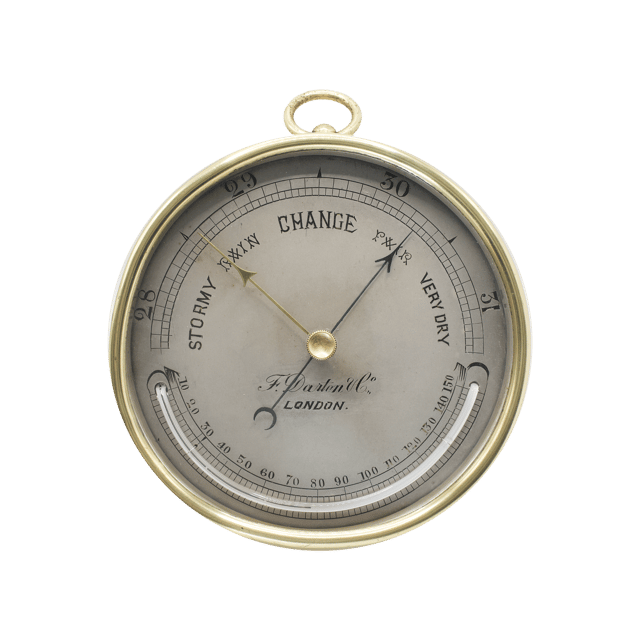
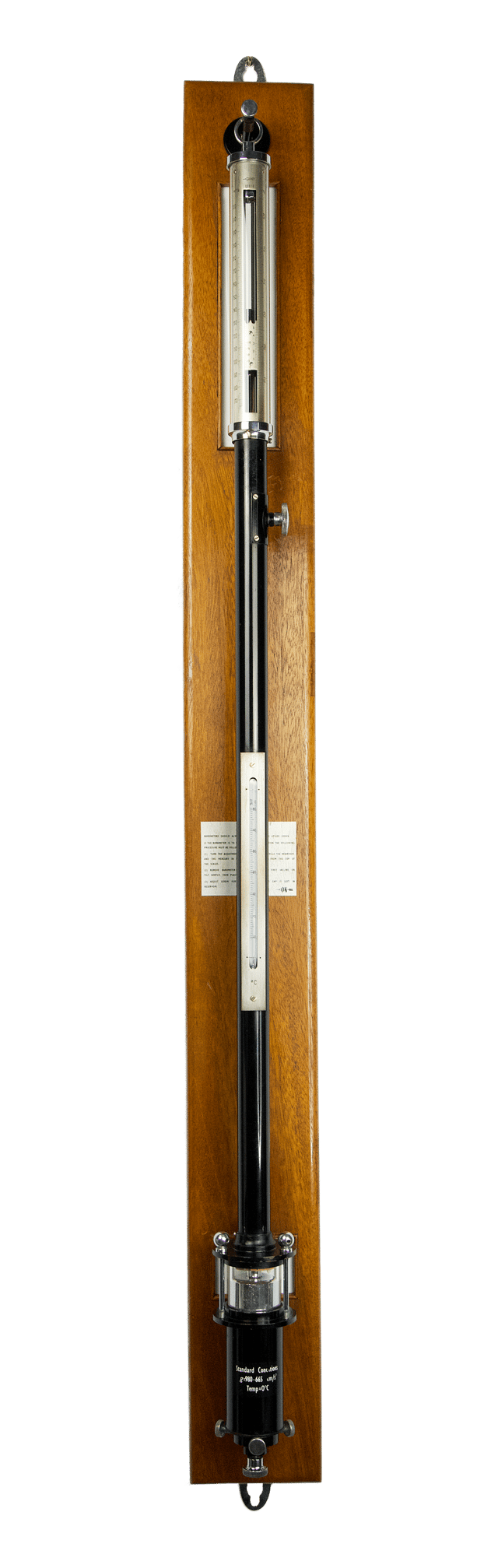
In Victorian London—where the smoke of factories mingled with the scent of Clerkenwell workshops, and the precision of instruments determined the fate of navigation, aviation, and science—there emerged a company whose name still resonates in auction catalogues of antique barometers and in the archives of meteorological services. F. Darton & Co. was not merely a manufacturer of barometers and aneroids. It was a story of continuity, relocation, partnerships, and survival through two world wars, stretching from 1834 to nearly the end of the 20th century. Its instruments served the British, French, and Japanese governments, were exhibited at world fairs, and recorded the weather for the Royal Meteorological Society.
1834–1870: Beginnings under the Name Oborne. Birth in Clerkenwell
It all began in 1834, during the reign of William IV. The business was founded by Benjamin Oborne, a young craftsman who had just completed his studies at the London Mechanics’ Institution (1831–1836). He opened a small optical and instrument workshop in Clerkenwell: first at 8 Northampton Buildings, Clerkenwell; then at 8 Garnault Place, Spa Fields; later at 11 Guildford Street, Spa Fields; and finally at 102 St. John Street, Clerkenwell.
Oborne produced spectacles, folding lorgnettes, opera glasses, and early scientific instruments. It was a typical craft workshop of the era: precision handwork, with clients including sailors, scientists, and enthusiasts. By 1870, Oborne had apparently retired or passed away, and the business transferred to Francis Darton, an optician and spectacle maker. Some sources suggest that Darton had been Oborne’s apprentice and simply “inherited” the workshop. In any case, 1870 marked a transition point: the Oborne name disappeared, and a new brand began to take shape—bearing the name Darton.
1870–1887: Francis Darton Takes the Helm. First Barometers and Government Contracts
Francis Darton quickly expanded the product range. By 1873, the firm appears as F. Darton and Co. on St. John Street, Clerkenwell. By 1875, it traded at 72 St. John Street, West Smithfield. Its principal products became barometers of all types: mercurial stick barometers, aneroid barometers, pocket instruments, marine barometers, as well as thermometers, anemometers (Robinson, Biram, Lind), and early barographs.
By 1880, advertisements proudly proclaimed: “Makers of all kinds of Barometers and Thermometers. Makers to the British, French and Japanese Governments.” The company attained the status of supplier to three empires—a rare distinction for a relatively small London firm. In 1878, it exhibited for the first time at the Paris Universal Exhibition. This marked a breakthrough: from a local optician to an international player.
In the classic English trade journal The Chemist and Druggist (15 October 1885), it is noted: “F. Darton & Co., manufacturers to H.M.’s Government, offer Improved Darton Clinical Thermometers with indestructible index, which, as noted in The Lancet, Chemist and Druggist, etc., can only be obtained from the inventors and makers; they cannot get out of order and are therefore particularly suitable for export.”
1887–1901: Partnership and Flourishing. Frederick George Phillips and Francis Arthur Darton
In 1887, Frederick George Phillips joined the business—initially as an employee, later as a partner. The firm formally became F. Darton & Co. The move in 1892 to 142 St. John Street, Clerkenwell, provided expanded production space. By 1901, the company was led by Francis Arthur Darton (1850–1923), under whom it reached its peak.
The product line diversified: prism binoculars, microscopes, telescopes, electro-medical apparatus, and even small gas and oil engines (1/3 hp, 1904–1906). Yet the heart of the brand remained meteorological instruments—compensated aneroid barometer-altimeters, pocket compasses, and barographs in brass cases. Serial numbering suggests production on a significant scale while maintaining precision.
At the turn of the century, the firm actively operated within the pharmaceutical and medical trade. In The Chemist and Druggist, advertisements list, in a single breath, spectacles, barometers, clinical thermometers, microscopes, binoculars, and electrical apparatus—effectively offering a “complete world” of instruments for the educated practitioner.
The 1880s were marked by aggressive legitimisation through clients and titles. Advertisements prominently declared the status “MAKERS TO H.M.’S GOVERNMENT”. Another advertisement listed major medical institutions among its clientele: Royal London Ophthalmic Hospital, Central London Ophthalmic Hospital, Western Eye Hospital, St George’s Hospital, The London Hospital, Middlesex Hospital, and Guy’s Hospital.
From the official report La Meteorología en la Exposición Colombina de Chicago (1893): “The London firm Darton now produces aneroid barometers of a type in which a small lens is attached to the glass covering the instrument and can be easily rotated, embodying the idea of using a plano-convex lens that can move along the scale divisions of aneroids in order to read them conveniently, however small they may be.”
In Philip R. Collins’s book Aneroid Barometers and their Restoration, it is noted that around 1910 the company F. Darton & Co., then based in Clerkenwell, produced a wide range of barometers and scientific instruments as presented in its trade catalogues, and that in the period approximately between 1880 and 1920 it was likely among the leading manufacturers, supplying instruments, among others, to firms such as Negretti & Zambra and other instrument houses. At the same time, an important feature of Darton’s manufacturing practice was that until the 20th century the company rarely marked its products with its own name, instead using a trade mark in the form of a dart with the letters “O N” at the base, most commonly found on scientific barometers of the Fortin and Kew types, which significantly complicates the modern attribution of its instruments.
1903–1915: Exhibitions, Hallmarks, and International Recognition
Between 1903 and 1912, the company operated at 142 St. John Street and began working at 56–58 Clerkenwell Road. It actively participated in exhibitions: the Chicago World’s Columbian Exposition (1893), Brussels (1897), Milan International Exhibition (1906), the Model Engineers Exhibition in London (1907), and the British Industries Fair (1915).
In a book on meteorology at the Chicago World’s Fair, among the descriptions of numerous instruments by F. Darton & Co., there appears an interesting passage: “Aneroid barometers of various constructions, including a 5-inch barometer with a very open scale, readable to 0.01 inch (0.25 mm), as used in the Japanese Navy, suitable for surveying work.”
This statement underscores that such a model of aneroid barometer was employed by the Imperial Japanese Navy. In the early 20th century, aneroid barometers were actively used for the rapid determination of altitude above sea level in field conditions—on land, during landing operations, in coastal and island surveying, and similar tasks—particularly in naval and colonial expeditions. At that time, the Japanese fleet was rapidly expanding, conducting hydrographic work across the Pacific, in the Kuril Islands, Korea, and China—and such instruments were in high demand.
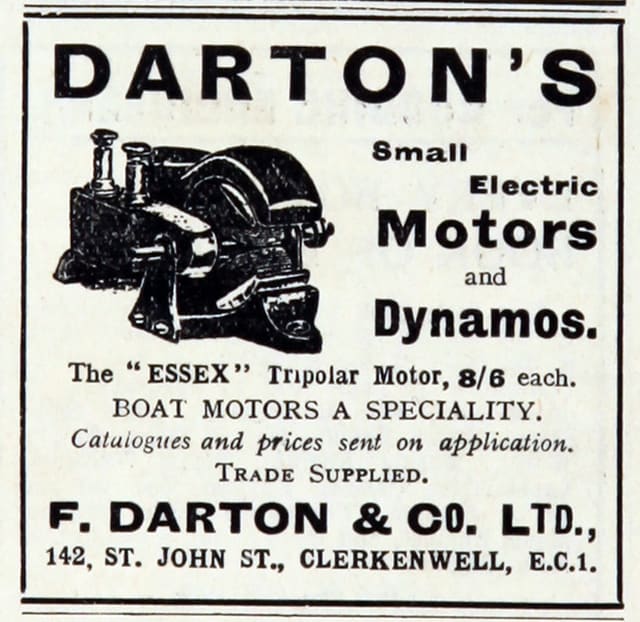
Marking the company’s “electrical turn,” a note published in February 1904 in the popular science journal Knowledge & Scientific News states: “Messrs. F. Darton and Co. have just issued their list of electrical novelties, which is notable for the low cost of most of the articles supplied by this firm. Among the novelties are: house telephones, hand gears, hand-geared dynamos for demonstration purposes, as well as their well-known small dynamos intended for use with small oil engines. In addition, the firm offers a number of attractive sets of small electric lighting installations, as well as economical motors for fans and light electric power work.”
This shift was institutionalised. A 1909 notice in The Chemist and Druggist mentions expanded premises at 52 Clerkenwell Road for electrical and scientific instrument production. The Milan Exhibition catalogue (1906) confirms a structured layout: Optical Works at 142 St John Street, Electrical Works at 31 Gloucester Street, and additional operations in Woodford (Essex).
Between 1903 and 1910, the company registered silver hallmarks at the London and Chester Assay Offices for the cases of pocket instruments, as well as for thermometer cases. Three hallmarks are known at the London Assay Office: “F.D” in a rectangular punch, registered on 17 February 1903; “F.D” in a rectangular punch, registered on 27 May 1904; and “F.D & Co.” in a rectangular punch, registered on 1 December 1909. The firm also registered a hallmark at the Chester Assay Office: “F.D” in a hexagonal punch on 8 May 1910. This confirmed premium quality. Darton supplied instruments to the Royal Meteorological Society; Francis Arthur Darton himself was a member (F.R.Met.S.).
1921–1930s: Liquidation, Revival, and Move to Watford
In 1921, the firm became a limited company: F. Darton & Co. Ltd. After the death of Francis Arthur Darton in 1923, difficulties followed.
The company entered voluntary liquidation in 1925, but was re-established as F. Darton & Co. (1925) Ltd., and subsequently reorganised again in 1930 as F. Darton & Co. Ltd. The company exhibited at the Paris Exhibition of 1878, the Chicago Exhibition of 1893, the Brussels Exhibition of 1897, the Milan Exhibition of 1906, the Model Engineers Exhibition in London in 1907, and the British Industries Fair in 1915.
The move to Watford (Yale Road, Bushey, Herts) provided modern facilities. Here, anemometers, barographs, hygrometers, rain gauges (recording rain gauges—well-known models for the Met Office), thermographs, and educational equipment were produced. Instruments were supplied to the Air Ministry and the Meteorological Office; marine barometers Mk II remained in service until 1969 (as indicated by service dates on some surviving examples).
1940s–1990s: Final Decades. Legacy in Museums and Collections
During and after World War II, Darton continued to work for government contracts. Instruments from 1947 are still found in Irish museum collections. The company survived into the 1990s—an exceptional lifespan for a Victorian brand. The Science Museum Group dates its core period to 1879–1924 but acknowledges the successor company (1925) Ltd.
The company continued operating until the late decades of the 20th century, after which it was absorbed by Russell Scientific, itself closing in 2022—bringing to an end nearly two centuries of instrument-making history.
Complete Known Product Range (Based on Sources)
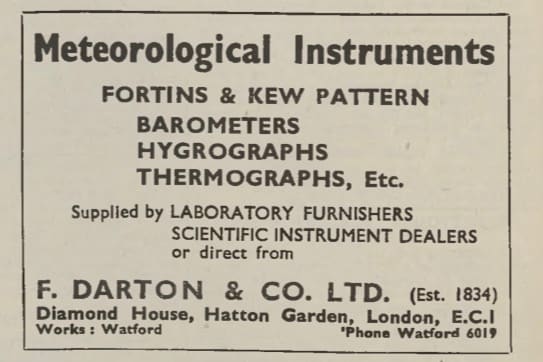
Advertisements (1910) explicitly list “ANEROID and MERCURIAL BAROMETERS.” 1940s advertisements in Nature specify “meteorological instruments”: Fortin and Kew Pattern barometers, hygrographs, thermographs. Even 1880s trade advertisements describe barometers as “always on hand.”
1880s advertisements promote clinical thermometers, with optional Kew certification. The 1893 Chicago report records Darton thermographs and specialised thermometers for radiation and soil measurements.
The Science Museum Group records a 1946 precision hair hygrometer (Watford production). Thermohygrographs confirm continued specialisation in meteorological recording.
The 1900 South Kensington catalogue lists “Lind’s Water Anemometer… Lent by F. Darton & Co.”
Advertisements (1914–1916) present the firm as “Manufacturing Opticians.” Listings include cyclists’ goggles, army telescopes, and field/opera glasses.
As noted in 1904 and later trade journals: small lamps, flashlights, and electrical demonstration equipment. The 1906 Milan catalogue formally separates Optical and Electrical Works.
Museum records (Ingenium, Canada) show markings “DARTON OF WATFORD, ENGLAND.” Auction records include sextants with Kew Observatory certification (1898).
Sources:
Direct links to key sources: