Loading
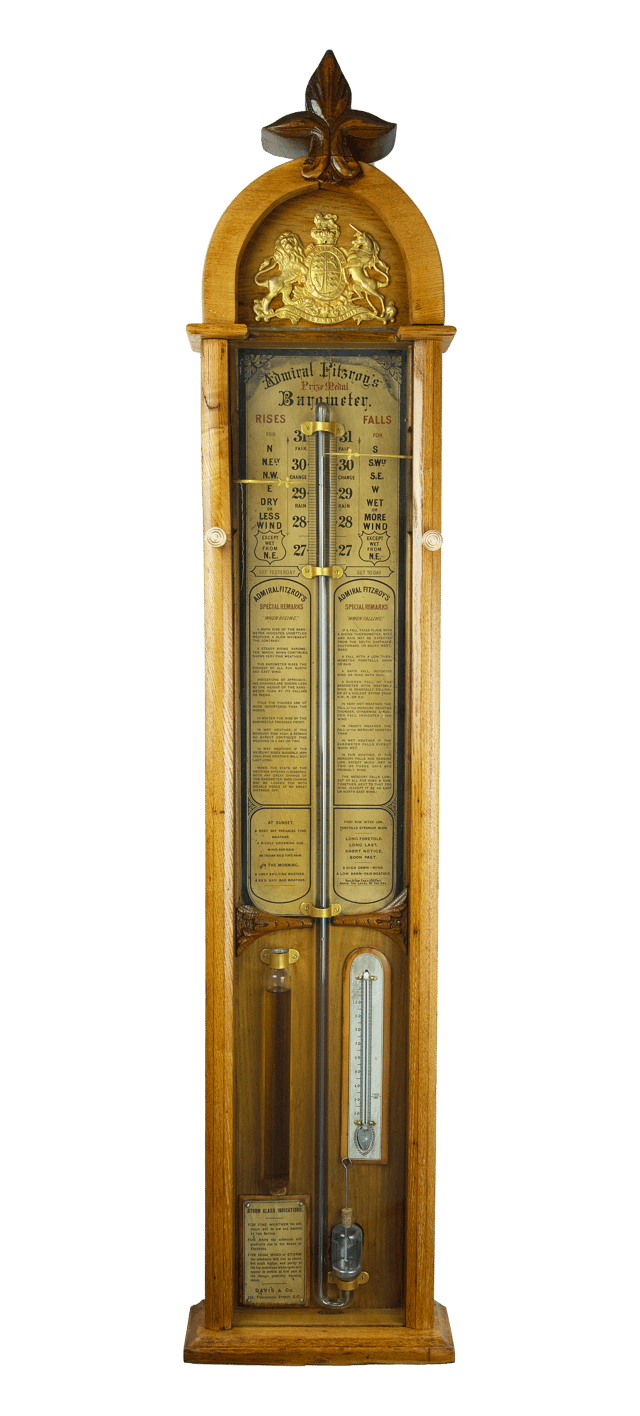
Joseph Davis & Co. was a London-based manufacturer of scientific and meteorological instruments, active primarily in the second half of the nineteenth century. The firm is best known as one of the principal producers of the popular Victorian “Admiral FitzRoy” barometers.
The company began operations around 1868 at 163 Fenchurch Street, E.C. (London), a central commercial district of the City well suited for the trade in scientific instruments. The earliest known examples of their FitzRoy barometers (c. 1868–1870) originate from this address, including the “Admiral FitzRoy’s Prize Medal Barometer” bearing a Registry of Design label dated 1868.
Reliable details concerning the firm’s early history prior to 1868, as well as precise information about its founders, remain scarce in published sources. The company appears to have been a relatively small, specialized workshop that emerged in response to the growing public interest in meteorology following the publications and initiatives of Vice-Admiral Robert FitzRoy (1805–1865). FitzRoy, captain of HMS Beagle during the Darwin expedition, became a pioneer of systematic weather forecasting in Britain; after his death in 1865, his methods and interpretive “scripts” for reading barometers were widely adopted by commercial manufacturers.
By 1870–1871 the company had relocated (or established its principal works and warehouse) to the Kennington Park area, operating from Fitzroy Works, London S.E. (often given as 6 Kennington Park Road). It remained active there at least until 1893. At this site the firm styled itself as “Sole Manufacturers of Polytechnic Barometers” and produced instruments marketed as the Royal Polytechnic Barometer.
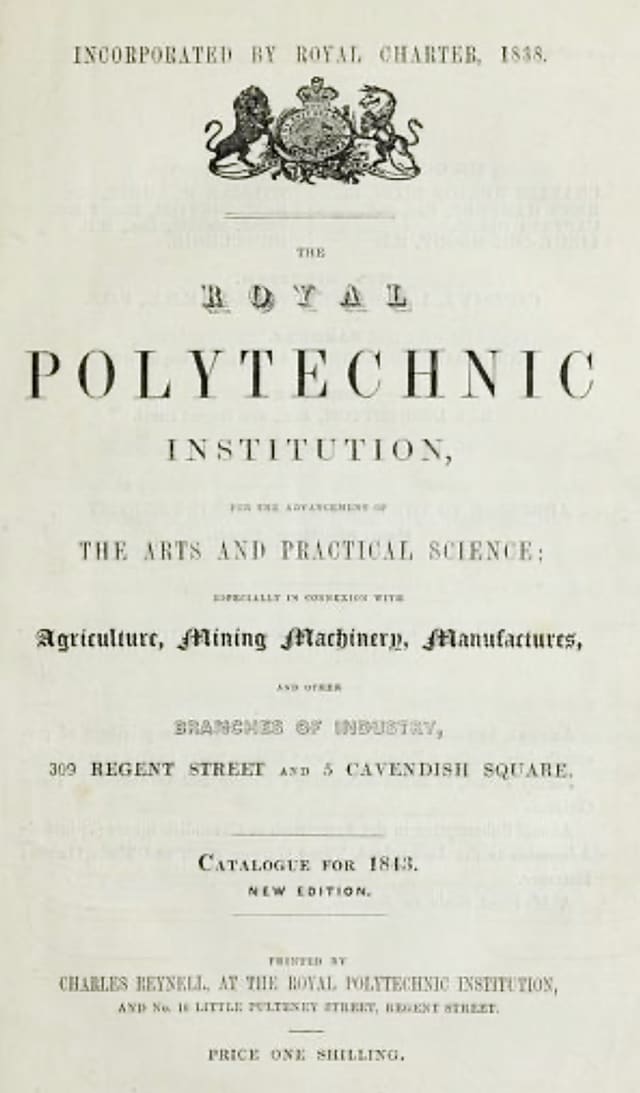
The Royal Polytechnic Institution was a hybrid entity combining elements of a public scientific theatre, exhibition space, educational establishment, and commercial showcase for inventors and manufacturers. It originated from the initiative of Charles Payne, former manager of the Adelaide Gallery, and was financed by the builder William Mountford Nurse. The institution opened in August 1838 under the presidency of Sir George Cayley. The house at 5 Cavendish Square was acquired, and a new building designed by James Thomson was constructed over its garden and adjoining mews, with an entrance on Regent Street.
It opened to the public on 6 August 1838. Its stated mission was characteristic of the British context: to provide a place where the public, “for a small fee,” could acquire practical knowledge of the arts and sciences related to industry, mining, and agriculture. From the outset, the Polytechnic was conceived not as a closed engineering school in the continental (French) sense, but as a semi-public, semi-exhibitional mechanism for the dissemination of useful knowledge.
Institutionally, it was designed to “instruct and entertain” simultaneously. It included a Great Hall, lecture rooms, laboratories, a diving bell, demonstrations of new technologies, early photographic displays, and later a theatre featuring magic lantern shows and optical illusions.
The term polytechnic in nineteenth-century British usage did not carry the same meaning as the continental École polytechnique. In Britain, it initially denoted an institution concerned with multiple practical arts—applied science combined with popular education. Only toward the end of the century, particularly with developments such as Hogg’s Regent Street Polytechnic, did the term become associated with a more formalized type of educational institution.
By the nature of its mission, the Royal Polytechnic Institution was closely integrated with the trade in scientific instruments. Contemporary sources indicate that it:
This is the context in which Joseph Davis & Co. must be understood.
The Science Museum Group describes the Royal Polytechnic Barometer as an object manufactured circa 1870–1885, explicitly identifying it as a “trade mark and design-registered, Davis and Co.” product. This indicates that the term “Royal Polytechnic Barometer” was not an internal product of the institution itself, but a commercial, trademarked design by Davis, associated with the prestige and exhibition function of the Royal Polytechnic.
For Joseph Davis & Co., the most plausible interpretation is that the firm used the name Royal Polytechnic as a form of commercial and marketing capitalization on a real exhibition or trade relationship with the institution, rather than as evidence that it was structurally part of it.
By the early 1880s Joseph Davis & Co. had evolved beyond a narrow manufacturer of a single “FitzRoy barometer” into a broad supplier of meteorological, marine, and applied measuring instruments. Official literature from the International Fisheries Exhibition of 1883 lists the firm’s products from Kennington Park Road under the Fitzroy Works name: the Royal Polytechnic Barometer incorporating the “Admiral FitzRoy’s Prize Medal Barometer,” collections of similar instruments in various woods and finishes, marine barometers, aneroid barometers for fishermen, compasses, telescopes and marine glasses, salinometers, specific gravity testing apparatus, thermometers, and scientific instruments. This wide and technically oriented catalogue demonstrates that barometers formed the core, but not the limit, of the firm’s activity.
Contemporary accounts also reveal a second dimension of the business: a deliberate orientation toward the domestic, interior, and pharmaceutical market. A reviewer in The Chemist and Druggist (1884) noted, with some irony, that Joseph Davis & Co.’s barometers were offered in Ionic, Gothic, Mediaeval, and Irish black oak frames, clearly intended to serve as “permanent ornaments of chemists’ shops.” In the same review, Davis was also listed among exhibitors of thermometers “for all purposes.” The firm thus sold not only functional instruments, but stylized objects suited to the Victorian interior—a scientific device transformed into a decorative furnishing.
Another significant layer of the product range consisted of analytical and sanitary instruments. The catalogue of the Health Exhibition of 1884 associates Joseph Davis & Co. with milk analysis instruments, milk and cream tests, water-testing apparatus, and various scientific testing devices. It is also recorded that in 1877, at the Highland and Agricultural Society exhibition in Aberdeen, the firm presented water-testing apparatus; although the tests were deemed well known, they were considered too complex for non-chemists and were not awarded a prize. While a failure in competitive terms, this provides valuable historical evidence that Davis sought to operate in the field of applied sanitary chemistry.
The firm also produced specialized domestic and practical thermometers. In an 1889 article on cooking in Popular Science Monthly, the author explicitly mentions importing from England an oven thermometer manufactured by Joseph Davis & Co., Fitzroy Works, London, S.E., purchased at an agricultural exhibition. By 1892 the company received a Certificate of Merit for its “American Forecast Barometer,” described as having an oak or walnut frame, a large mercury column, summer and winter forecasting scales, a floating compass at the base, dimensions of 41 × 12 inches, and a price of £4 4s. This demonstrates not only the firm’s continued vitality into the early 1890s, but also its capacity to elaborate the original FitzRoy concept into a complex, multifunctional forecasting instrument for domestic use.
The FitzRoy Barometer
It is essential to distinguish between three related but distinct contexts. The first is the official FitzRoy system of practical weather forecasting, associated with Robert FitzRoy and the Board of Trade. In The Barometer and Weather Guide (1859), the method relies on careful reading of an ordinary mercury barometer: a rising column generally indicates drier and calmer weather, a falling column suggests wind or rain, and interpretation depends on change over time rather than a single reading.
In the same work, FitzRoy explicitly notes that hermetically sealed “storm glasses” are influenced by causes other than pressure and temperature. In other words, for FitzRoy himself, the mercury barometer remained the central instrument, while the storm glass was auxiliary and scientifically questionable.
The second context consists of coastal and port-based “public” FitzRoy barometers, intended to be installed in accessible locations for fishermen and sailors before going to sea. These were produced by Negretti & Zambra. It is from this official context that all later “FitzRoy barometers” ultimately derive.
The third context—into which the present object falls—is the domestic and commercial reinterpretation of the same idea. Davis transformed FitzRoy’s methodology into a wall-mounted cabinet instrument: instead of a single measuring column, the user encountered a complete visual system—heraldic device, printed rules, seasonal scales, textual “special remarks,” a storm glass, thermometer, and sometimes an atmospheric height scale. This was no longer port infrastructure nor a shipboard marine barometer, but a Victorian interior “weather manual” mounted on the wall.
This domestic orientation is confirmed both by the pharmaceutical context noted in 1884 and by museum attributions of later Royal Polytechnic barometers as instruments designed to use yesterday’s pressure to forecast today’s weather. In Davis’s version of the FitzRoy barometer, the priority was to make forecasting visible, readable, and commercially viable within the room—whether in a home, pharmacy, hall, office, or shop.
Conclusion
Taken as a whole, the history of Joseph Davis & Co. illustrates a characteristic Victorian trajectory: the transformation of a state-backed scientific method into a commercially adaptable, visually codified, and domestically integrated object. By leveraging the authority of FitzRoy’s system and the prestige associated with the Royal Polytechnic Institution, the firm positioned itself at the intersection of science, trade, and interior culture. Its instruments are therefore not merely measuring devices, but material evidence of how nineteenth-century Britain translated meteorological knowledge into both a market commodity and a readable element of everyday life.
Sources:
Charles Edwin – Barometers https://www.charlesedwin.com/brmsold.htm
The British Section at the Vienna Universal Exhibition, 1873 – Official Catalogue https://archive.org/details/gri_33125008618312
International Fisheries Exhibition, London 1883 – Official Catalogue https://archive.org/details/fisheriesexhibit12londrich
The Popular Science Monthly, Volume 36 (1889–1890) https://en.wikisource.org/wiki/Page:Popular_Science_Monthly_Volume_36.djvu/12
Medical and Scientific Historical Text (19th century, digitized manuscript) https://archive.org/stream/b19974760M0284/b19974760M0284_djvu.txt
Exposição Internacional de Higiene, Lisbon 1884 – Official Catalogue https://www.scribd.com/document/694709494/Catalogo-Exposicao-Internacional-de-Higiene-1884
Post Office London Directory (1860s–1870s editions) https://specialcollections.le.ac.uk/digital/collection/p16445coll4
Kelly’s Directory of London (1860s–1880s) https://cdm16445.contentdm.oclc.org/digital/collection/p16445coll4
Grace’s Guide to British Industrial History – Scientific Instrument Makers https://www.gracesguide.co.uk/
Meteorological Office (UK) – History of FitzRoy Barometers https://www.metoffice.gov.uk/weather/learn-about/met-office/history
The Royal Polytechnic Institution … Catalogue for 1843 https://archive.org/details/royalpolytechnic00roya
Royal Polytechnic Programme, week commencing December 28, 1874 https://www.londonmuseum.org.uk/collections/v/object-461882/royal-polytechnic-programme/
Prince Albert and Royal Polytechnic Institution images / archive note https://recordsandarchives.westminster.ac.uk/royalconnections-1/
Royal Polytechnic Institution Handbill, c1840–1870 https://archives.shef.ac.uk/repositories/2/archival_objects/16409
Royal Polytechnic Barometer, Science Museum Group https://collection.sciencemuseumgroup.org.uk/objects/co523815/royal-polytechnic-barometer