Loading
D. Köhn was a Hamburg optician of the mid-19th century. According to archival records, he originally founded his optical business in 1852. In an advertisement from the late 1880s he stated: “Optisches Institut von D. Köhn, Jungfernstieg … Hamburg. … Etablirt 1852 Hannover” — indicating that the Optical Institute of D. Köhn, located on Jungfernstieg in Hamburg, was founded in 1852.
Around 1887, D. Köhn expanded his business and opened a branch (or relocated his operations) in Hamburg, in the prestigious premises of the Hamburger Hof hotel at Jungfernstieg 33. Local newspapers at the time reported a “Geschäfts-Eröffnung” (store opening) of D. Köhn on Jungfernstieg. This shows that by the late 1880s, the Optical Institute of D. Köhn had firmly established itself in Hamburg and attracted public attention with its new storefront. A location on Jungfernstieg — the city’s principal boulevard — reflects the high status of the firm among contemporary merchants.
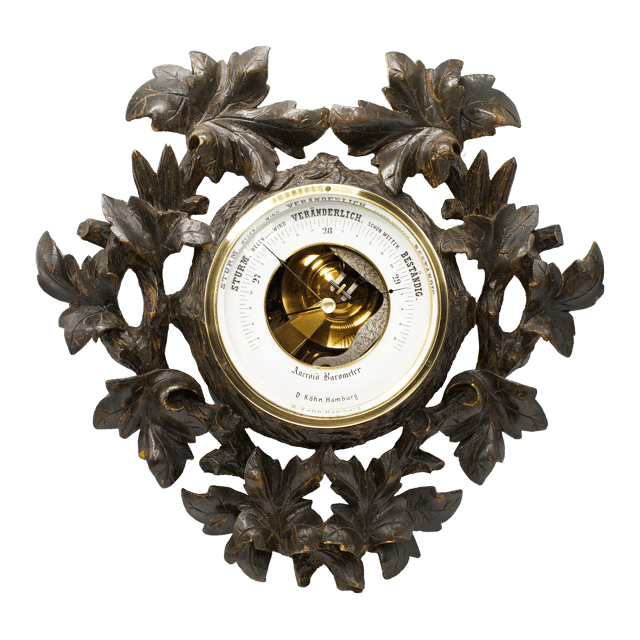
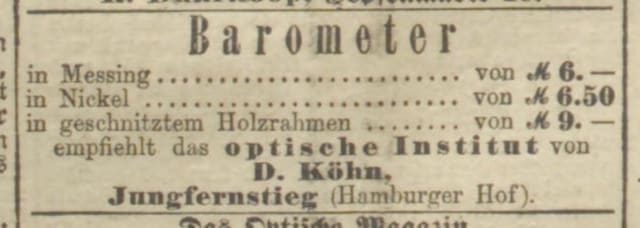
In his advertising, D. Köhn emphasized the quality and precision of his optical products. For example, he specifically mentioned the manufacture of spectacles according to medical prescriptions (“Brillen nach ärztlichen Vorschriften genau angefertigt”), indicating his reputation as a qualified optician. In addition to spectacles, his inventory included other scientific instruments, including barometers. In another advertisement published in Hamburger Fremden-Blatt, Nr. 200, 59th year, 27 August 1887 (Hamburg), the Optical Institute of D. Köhn offered barometers in brass cases, nickel cases, and carved wooden frames.
Judging by the nature of his business, D. Köhn acted primarily as a merchant and optical technician rather than as an independent manufacturer of barometers. In the 19th century, it was common for opticians and scientific instrument shops to place their own names on instruments that were in fact produced by specialized factories. D. Köhn appears to have done the same: he supplied barometers and other meteorological instruments under his own brand, while the mechanisms themselves were likely produced by established instrument makers (in France, England, or Germany). No direct evidence of in-house barometer manufacturing by Köhn has been found in available sources. His firm was described as an “Optisches Institut”, implying a workshop for the fabrication and adjustment of optical devices (primarily spectacles, and possibly telescopes or microscopes), but not necessarily for the complete fabrication of complex measuring instruments.
Nonetheless, D. Köhn played a noticeable role in the distribution of scientific instruments. His optical institute served as a point of sale and circulation for various instruments in Hamburg. He supplied measuring devices (barometers, thermometers, compasses, etc.) for scientific and everyday needs. Due to his long experience (since 1852) and his position in a major port city, the Köhn firm could import new products and distribute them widely. It is also notable that D. Köhn advertised not only in local Hamburg newspapers, but also in the Vienna Neue Freie Presse, which suggests an attempt to attract international clientele and indicates the firm’s role in spreading scientific instruments beyond Hamburg. It is likely that travelers and sailors passing through Hamburg purchased instruments from him and disseminated them across Europe and abroad.
Thus, D. Köhn was primarily a retailer and intermediary in the scientific and optical instrument market, ensuring access, adjustment, and servicing for customers. His contribution lay less in the invention of new instruments than in the professional selection of high-quality apparatus and the popularization of precise measurement among the educated public.
The firm of D. Köhn existed for several decades, but references to it become increasingly rare by the early 20th century. After the founder’s death or retirement (exact biographical details have not survived in accessible records), no direct successors of the same name appear in Hamburg trade directories. The business likely ceased operation or was transferred to an unrelated party.
Sources: