Loading
The company D. Brauckmann & Co. was founded in Hamburg in the second half of the 19th century and specialized in the manufacture and sale of optical and precision instruments. Its founder was presumably born in the first third of the 19th century and received training in optics and precision mechanics. In the 1850s–1860s, Brauckmann began independent activity as a master optician and dealer in scientific instruments, which eventually led to the establishment of his own firm, D. Brauckmann & Co., in Hamburg. The company was positioned as an (Optical Institute), a designation that emphasized its specialization in optical and precision instruments and the high quality of its products. In 19th-century Germany, the term had a strictly professional rather than academic meaning. It referred to a combined workshop, laboratory, and commercial enterprise engaged in the development, calibration, manufacture, and sale of optical and precision instruments.
Initially, Brauckmann’s workshop was located in one of Hamburg’s central buildings. It is known, for example, that in 1883 his optical workshop occupied the ground floor of a building where it neighbored a shoemaker’s shop belonging to a certain J. M. Kohn; however, by 1884 Brauckmann had moved out, probably expanding his business and relocating to larger premises in the city center. Thus, from its earliest years, Brauckmann & Co. established itself as one of the leading private optical institutes in Hamburg in the second half of the 19th century.
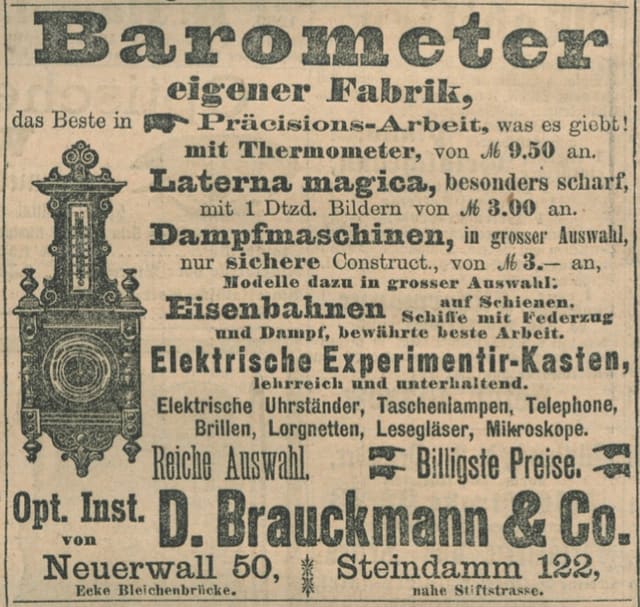
By the 1870s–1880s, D. Brauckmann & Co. had firmly established itself on the Hamburg market for scientific instruments. The shop and workshop were located at the prestigious address Neuer Wall 50 in central Hamburg (corner of Bleichenbrücke), and an additional branch operated at Steindamm 57. The existence of two retail locations indicates the company’s commercial success and strong demand for its products. An advertisement from 1890 refers to Brauckmann & Co. as an “Optical Institute” and emphasizes its principal specialization—the manufacture and sale of theatre binoculars (opera glasses). It advertises “specialty: opera glasses of new designs, the widest selection; exclusively first-class optics at the most favorable fixed prices, starting from 8.5 marks.” Thus, by the end of the 19th century, Brauckmann’s firm had become one of the notable suppliers of portable optical instruments to a broad consumer audience.
In addition to its central salon on Neuer Wall, the firm maintained a branch on Steindamm (in the St. Georg district), allowing it to reach different segments of customers. In late-19th-century Hamburg address books, Brauckmann & Co. is listed among opticians, offering spectacles, binoculars, lorgnettes, magnifying glasses, microscopes, and other instruments. Indeed, a company advertisement published in the Hamburg press in 1904 states that at D. Brauckmann & Co. one could purchase “spectacles, lorgnettes, magnifiers, microscopes—a huge selection at the most affordable prices.” By the height of the firm’s development, its product range had thus expanded significantly beyond the initial specialization in theatre binoculars, transforming the company into a comprehensive retailer of optical and precision instruments.
The 1904 advertisement indicates that the shops of D. Brauckmann & Co. operated at two addresses: Neuer Wall 50 (corner of Bleichenbrücke) and Steindamm 122. Apparently, at the turn of the century the Steindamm branch was relocated from No. 57 to No. 122, possibly into a more spacious building. By the early 20th century, the firm therefore maintained one sales outlet in the fashionable city center (Neuer Wall) and another in the busy commercial district of Steindamm.
Brauckmann & Co. offered an exceptionally broad range of optical, scientific, and measuring instruments. Advertisements from the early 20th century emphasized that Brauckmann carried a “large assortment” of optical goods at “the most affordable prices.” The principal product categories for which the company was known include the following:
Theatre and field binoculars. Opera glasses were Brauckmann’s signature specialty. He offered the latest models in elegant designs, aimed at theatre and opera audiences. According to advertising, the selection was very extensive, and the optical quality was emphasized as “first-class,” appealing to discerning customers. In addition, more powerful field binoculars for travelers or military use were likely offered, although the primary focus remained on refined, compact theatre glasses.
Spectacles and reading optics. Like many optical institutes of the period, Brauckmann & Co. served the everyday needs of city residents for corrective optics. The assortment included spectacles, monocles, lorgnettes, and various magnifying devices—hand lenses, reading glasses, and desk magnifiers. The firm was able to custom-fit spectacles to the client’s eyesight, functioning as a full-service optical salon. By the early 20th century, with advances in lens-grinding technology, such services were in high demand, and the presence of an in-house optician constituted a significant competitive advantage.
Scientific instruments. Brauckmann & Co. also traded in precision measuring and scientific demonstration instruments. Microscopes are specifically mentioned in the assortment; at that time, microscopes were not only scientific tools but also popular items among educated amateurs interested in natural science. The firm likely also offered other instruments—telescopes, spyglasses, and possibly geodetic or navigational instruments—falling under the category of “optical and precision instruments” stated in the company profile.
Photographic equipment. By the late 19th century, photography was experiencing a boom, and Brauckmann & Co. participated actively in this market. Advertisements from the late 1880s mention a “large stock of photographic cameras (including so-called detective cameras), tripods, lenses, photographic paper, and all related accessories.” This indicates that the firm sold cameras and photographic supplies. Brauckmann probably did not manufacture cameras himself but acted as a dealer for established manufacturers; however, his status as an optician added credibility to the quality of photographic lenses and accessories sold. In this way, the company expanded into the adjacent field of photographic technology, broadening its clientele to include both professional and amateur photographers.
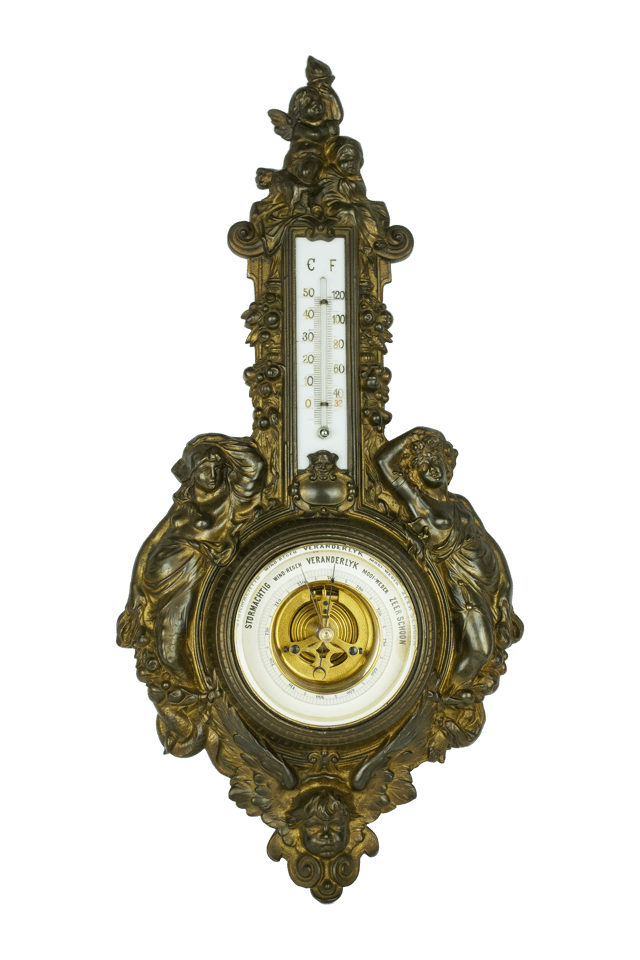
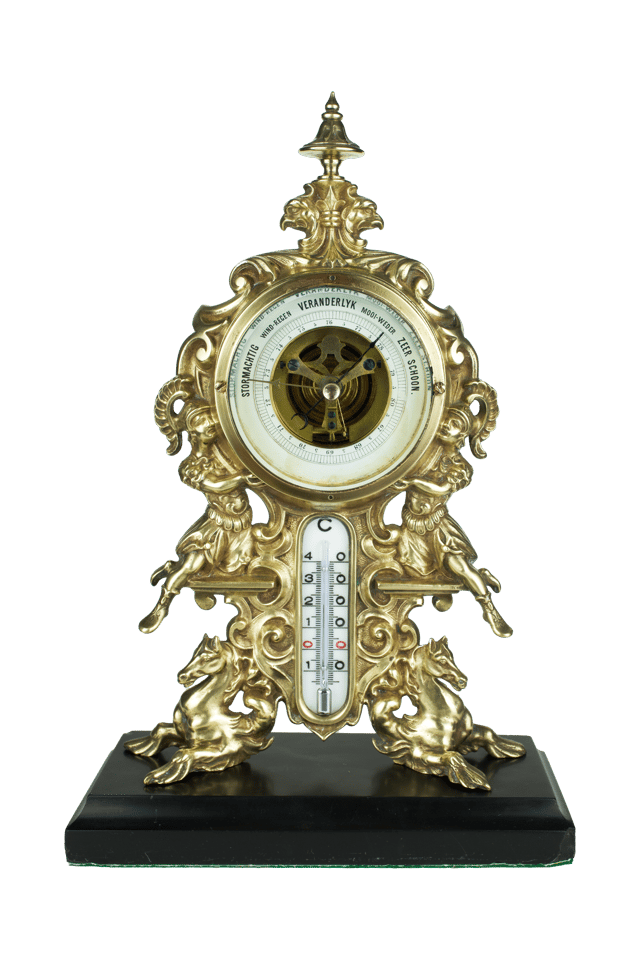
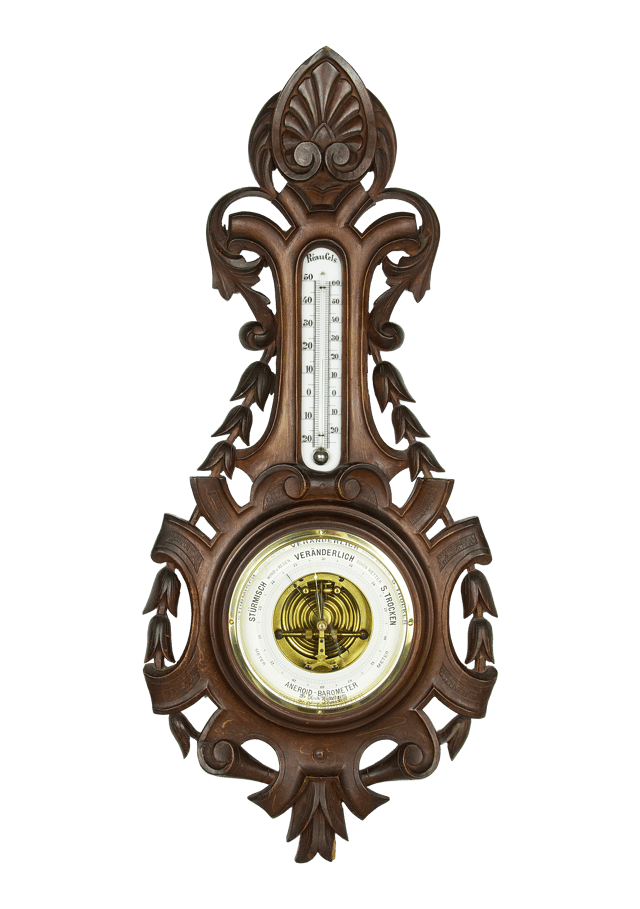
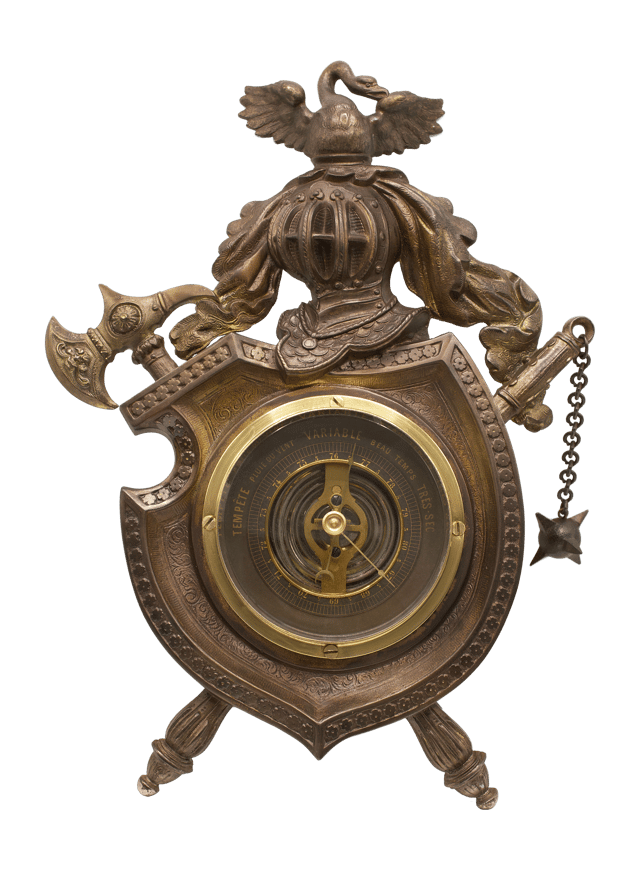
Meteorological instruments. Another important product group consisted of barometers, thermometers, and other weather-measuring instruments. In the Victorian era, domestic barometers and weather stations were fashionable and useful household objects. Brauckmann & Co. offered both traditional mercury barometers and modern aneroid barometers. It was precisely in the field of barometers that the firm achieved particularly original developments. Contemporary press sources also noted the high quality of the thermometers and other meteorological instruments produced by the company. By expanding in this direction, Brauckmann effectively transformed his firm into a comprehensive supplier of meteorological and scientific instruments alongside optical goods.
Projection and educational equipment. An interesting chapter in the firm’s history is its involvement in the production of accessories for magic lanterns (projection devices) and educational visual aids. The company manufactured or at least sold sets of projection slides for early multimedia presentations. The subjects of these slides ranged from views of foreign countries to scientific illustrations. This is indirectly confirmed by surviving sets of magic-lantern slides bearing the mark “Brauckmann, Hamburg.” For example, series of glass slides from the late 19th century depicting Switzerland, Greece, the United States, and other locations are known with the Brauckmann stamp. These slides were likely sold as ready-made sets for lecturers and schools, with Brauckmann acting as publisher or distributor. The firm may also have sold the projection lanterns themselves and related accessories, meeting the demand for popular scientific entertainment of the period.
By the end of the 19th and the beginning of the 20th century, Brauckmann & Co. thus offered an almost complete spectrum of optical, photographic, physical, and meteorological instruments. From a small optical workshop, it grew into one of Hamburg’s most versatile private firms in this field.
Brauckmann & Co. quickly gained a reputation for producing high-quality instruments. The company achieved particular recognition in the field of aneroid barometers. In the 1880s, the firm developed original aneroid mechanisms distinguished by unconventional forms and technical solutions. These unusual Brauckmann barometers stood out among competitors, and it was precisely for them that the company received official commendation.
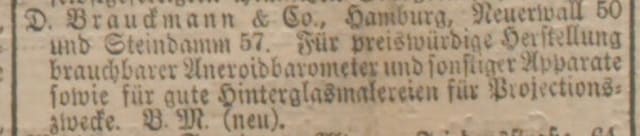
On October 4, 1889, the newspaper Hamburger Fremdenblatt reported that D. Brauckmann & Co. of Hamburg was specially recognized “for the award-worthy manufacture of practically usable aneroid barometers and other instruments, as well as for high-quality reverse glass paintings intended for projection purposes.” This notice testifies to the practical value and high quality of Brauckmann’s products. The notation “B. M. (neu)” at the end of the text stands for Bronzene Medaille (“bronze medal”). The addition indicates that the medal had been awarded recently, emphasizing a current exhibition success rather than an old honor. The mention of (reverse glass paintings for projection) further confirms that the firm produced painted glass slides for magic lanterns and projection devices—another branch of precision craftsmanship of the period.
In addition to the 1889 notice, Brauckmann & Co. regularly placed advertisements in Hamburg newspapers. These advertisements emphasized the breadth of the assortment and affordable prices. For example, in December 1904 the Hamburger Fremdenblatt recommended Christmas gifts and mentioned Brauckmann’s shop among the best places to purchase optical goods: “Spectacles, lorgnettes, magnifiers, microscopes—a huge selection, the lowest prices at D. Brauckmann & Co., Neuer Wall 50, corner of Bleichenbrücke; Steindamm 122.” This shows that by the early 20th century the company remained a prominent player in the optical market.
Local chronicles also trace the relocation of Brauckmann’s shops. One source notes that around 1884 the Brauckmann workshop on Steindamm vacated its premises, which were subsequently occupied by a glassworker—likely referring to the move from No. 57 to a new address.
Overall, contemporary assessments of Brauckmann & Co. were positive. The firm was described as a “first-class optical institute,” emphasizing the competence of the master and the quality of the products. At the same time, Brauckmann succeeded in making instruments more affordable, targeting not only scientific institutions and wealthy clients but also a broad circle of technology enthusiasts. Advertisements therefore featured both expensive precision instruments (high-quality microscopes, chronometers, barometers) and inexpensive mass-market items (pocket magnifiers, alarm clocks, thermometers, etc.).
Brauckmann & Co. participated in various instrument-making exhibitions of the late 19th century, a fact confirmed directly by the instruments themselves. On the dial of a surviving aneroid barometer by Brauckmann, award medals are depicted with inscriptions referring to official industrial and international exhibitions. Specifically documented are a Gold Medal, Brussels 1888, awarded at the International Exhibition in Brussels, and a Bronze Medal, Hamburg 1889, associated with the Hamburg Industrial Exhibition of 1889. An additional medal labeled Ausstellung für Industrie und Gewerbe indicates participation in specialized industrial and craft exhibitions. Thus, Brauckmann & Co. not only competed with leading Hamburg optical-mechanical firms but also achieved official international recognition for the quality of its products. The practice of displaying exhibition awards directly on the instrument dial underscores the firm’s confidence in its technical level and served as a powerful marketing argument for late-19th-century customers.
In the early 20th century, the founder of the firm, Brauckmann, probably withdrew from active business due to age or health. Nevertheless, his life’s work continued: Brauckmann & Co. did not close but passed to successors. In such cases, firms were typically inherited by relatives or partners/employees, retaining the established trade name. Indeed, in address books and advertisements of the 1910s–1920s, the brand D. Brauckmann & Co. still appears, now with the designation “Nachf.”—an abbreviation of Nachfolger (“successor”). This indicates that after the founder’s departure, the firm formally changed ownership while continuing operations under the same name.
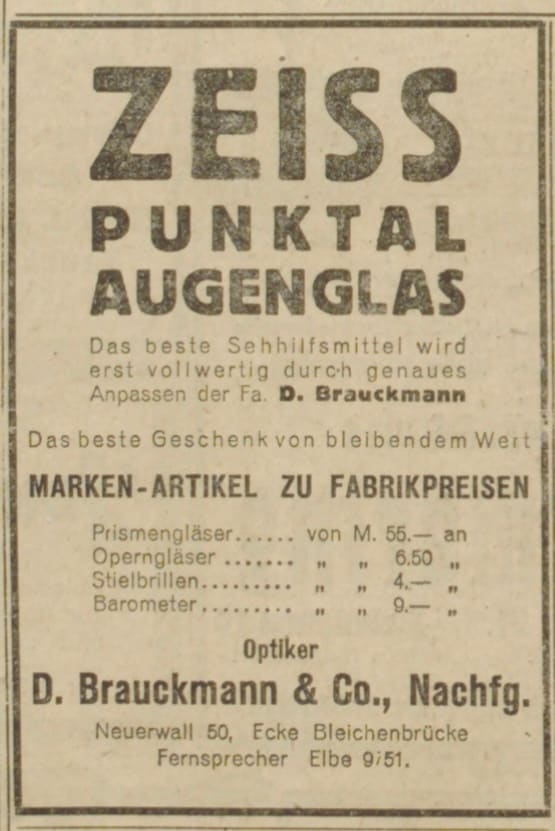
For example, a 1926 advertisement by the renowned company Zeiss lists among Hamburg optical shops “D. Brauckmann & Co., Nachf.” at the same address, Neuer Wall 50 (corner of Bleichenbrücke), telephone line Elbe 9751. The text explicitly states: “The best visual aid becomes truly complete only through precise fitting by D. Brauckmann,” pointing to cooperation between the two companies.
The firm continued to specialize in optics. In pre-Christmas advertising of that year, Brauckmann & Co. recommended prism binoculars, opera glasses, pince-nez, and barometers as gifts—items for which it had long been known. New mentions of gramophones and records appear, indicating an attempt to keep pace with the times and expand into household technology. Nevertheless, optical and precision instruments remained the core business. The fact that the firm survived at least until the late 1920s demonstrates its resilience, having endured both the First World War and the postwar inflation.
As for the company’s later fate, indirect evidence suggests that Brauckmann & Co. ceased operations in the 1930s. During the economically difficult years of the Great Depression, many long-established private enterprises struggled to survive. Moreover, the industry itself changed: small optical institutes gave way to large factories or specialized retail shops selling industrially produced goods. It is likely that in the early 1930s Brauckmann’s successors either liquidated or sold the business.
Thus, the history of Brauckmann & Co. came to an end approximately 70–80 years after its foundation. The company evolved from a modest workshop of the 1850s into one of Hamburg’s leading optical and instrument retailers at the turn of the century, left its mark through unique instruments—especially barometers—and outlived its founder by several decades. Although the name Brauckmann is today known to only a few specialists, its products—antique barometers, binoculars, and optical instruments—continue to attract collectors and preserve the memory of the high quality of Hamburg precision craftsmanship of the 19th century.