Loading


The history of the Arrouit company has been reconstructed on the basis of available sources (primarily French archival records, exhibition catalogues, and patent documentation, including FranceArchives, catalogues of the Exposition Universelle of 1878, Gallica BnF, Bottin/commercial directories, patent databases, and auction/collection references). However, information about the company remains extremely scarce.
Arrouit appears to have been a small Parisian workshop that existed for a relatively short period (circa 1878, or more broadly within the 1870s). Its founder was Léon Arrouit, likely a maker of precision instruments (fabricant d’instruments de précision), specializing in meteorological devices. No biographical data on the founder, nor dates of foundation or closure, successors, or continuation of the business after 1878, have been identified.
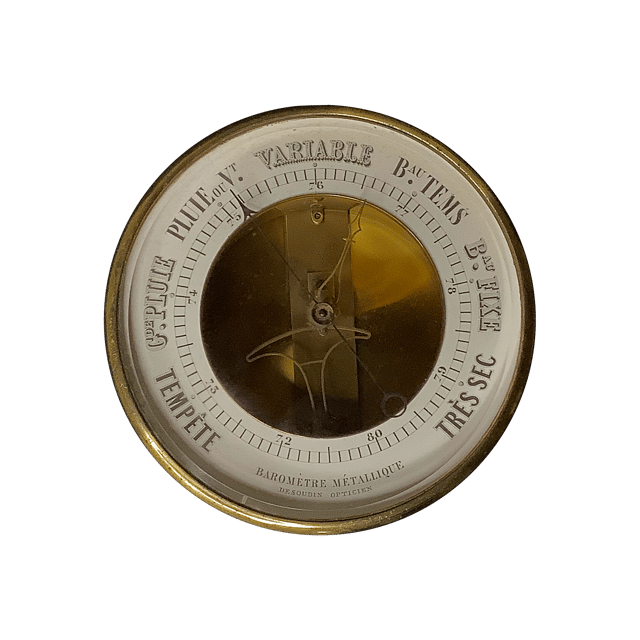
The workshop was located at 45, rue de l’Orillon, Paris. It produced aneroid and metallic barometers (baromètres anéroïdes et métalliques), as well as thermometers. The metallic barometers were based on the Bourdon tube principle, invented by Eugène Bourdon in 1849, the patent for which expired around the late 1860s–early 1870s. The form of the sector gear in Bourdon-type barometers produced by Arrouit clearly indicates a period after the expiration of Bourdon’s patent, yet before 1876.
In the 1891 edition of Annuaire des commerçants fabricants etc. de Paris (“Directory of Merchants, Manufacturers and Industrial Firms of Paris”), an important reference to the Arrouit firm appears in the section BAROMÈTRES.
The entry reads as follows: «ARROUIT (L.), (E. Delaporte succ.) — metallic aneroid barometers and thermometers, sextants and marine instruments, pocket barometers, mathematical instruments; accuracy guaranteed for 15 years; 1 rue Chariot.»
This entry clearly indicates that the firm of L. Arrouit was the successor to the company or workshop of E. Delaporte. The record also reveals the firm’s field of activity and provides the company’s address at 1 rue Chariot, Paris.
Another important reference to the Arrouit firm appears in the 1885 edition of the Annuaire de la Marine de Commerce Française, in the section Opticiens pour la marine — Paris. Here the company is listed as “Arrouit (Vve D.)”, with the address 45 rue de l’Orillon, Paris. The abbreviation “Vve” stands for veuve (“widow”). The entry therefore literally indicates that by 1885 the business was already being managed by the widow of Leon Arrouit — D. Arrouit.
The Annuaire de la Marine de Commerce Française itself was an official annual directory of the French merchant marine sector, published under the high patronage of the French Ministry of the Navy and Colonies. It contained information on shipping companies, suppliers of marine equipment, port services, navigational workshops, marine opticians, and manufacturers of scientific instruments connected with navigation and maritime activity.
The inclusion of the Arrouit firm in the section Opticiens pour la marine indicates that the company was recognised as a supplier or manufacturer of instruments intended for marine use, particularly navigational and meteorological instruments. The 1885 entry therefore confirms that Arrouit was already integrated into the professional sphere of the French marine instrument trade at that time.
The earliest reliably documented trace of Arrouit is a patent application dated 10 January 1865, entitled “Perfectionnements apportés aux baromètres, thermomètres, etc.”. In the FranceArchives record, the applicant is listed simply as ARROUIT, with the address Paris, 45 rue Saint-Sébastien, patent no. 65798, granted for 15 years; the patent agent was Jules Mathieu. This is a significant point: by early 1865, Arrouit was not merely trading instruments but positioning himself as an innovator contributing technical improvements to barometers and thermometers.
The next firmly established milestone is a second patent, filed on 19 March 1878, titled “Genre de baromètre métallique”, patent no. 123296, again for a term of 15 years. The address is now Paris, 95 boulevard Beaumarchais, and the patent agent is Charles Thirion. This indicates that between 1865 and 1878 the workshop or firm remained active and likely relocated or expanded its premises. The patent title itself confirms a specialization in metallic barometers, a field that saw significant development in the third quarter of the 19th century.
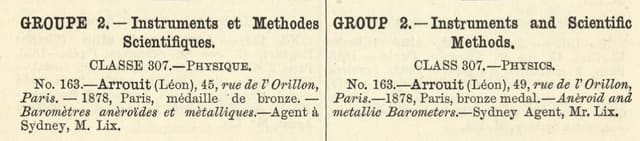
By 1878, the firm had entered the public stage. In the records of the Exposition Universelle de Paris 1878, the entry reads: “Arrouit (Léon), 45 rue de l’Orillon, Paris”, listing products as “baromètres anéroïdes et métalliques” and noting a bronze medal award. An agent in Sydney is also mentioned, which is particularly noteworthy: it suggests that the firm was not purely local but was attempting to engage with export markets.
As noted in the official report of the 1878 Exhibition, in the section on aneroid barometers (Lacroix, Eugène, Études sur l’Exposition de 1878, p. 463): “The aneroid barometers were carefully arranged in a single aisle, allowing one to observe in succession the instruments of Messrs. Perillat, Arrouit, Reclus, Hüe, etc. Almost everywhere, the ribbed box-type construction is adopted, with little or no modification.”
Following the Paris exhibition, the name Arrouit appears in Australia. In documents relating to the Sydney International Exhibition of 1879, “Arrouit, Leon, Paris” is listed among the exhibitors. In materials from the Melbourne International Exhibition of 1880, as well as in reports on awards, Arrouit is recorded as a participant in the class of measuring instruments; a newspaper account notes that “Arrouit, Paris, aneroids” received a “2nd, highly commended” distinction, while other listings identify the firm as a manufacturer of barometers, thermometers, and hydrometers. This confirms that the company was not ephemeral, but participated in a sequence of international exhibitions in the late 1870s and early 1880s.
From this evidence, the nature of the enterprise can be cautiously reconstructed. Arrouit was not merely a retailer of instruments produced by others but, most likely, a manufacturer or at least an assembling constructor of its own range of instruments. This is supported by the existence of patents, exhibition activity, and catalogue descriptions, where the firm is not described as a marchand (dealer), but is directly associated with instruments—barometers, thermometers, and hydrometers. In other words, Arrouit appears to have been a small Parisian firm operating within the circle of manufacturers of meteorological and precision instruments, positioned between a craft workshop and an export-oriented enterprise.
No evidence has been found of any personal acquaintance with Eugène Bourdon (1808–1884), nor of any contractual relationship, licensing agreement, or sustained collaboration. It is possible that Arrouit simply made use of the Bourdon tube design once it had entered the public domain following the expiration of the patent. In available sources, Arrouit appears only as an independent patent applicant and as an exhibition participant.
Arrouit operated precisely within the technical niche that emerged around metallic and aneroid barometers following the widespread adoption of Bourdon-type instruments. He was one of a second generation of Parisian manufacturers working in the field of metallic barometers, where the influence of the Bourdon tradition is evident, though no direct personal link can currently be documented.
A known identifying mark of the firm is its stamp: “AR” in a diamond-shaped cartouche, executed in a cursive script, which can be found on its instruments.
In Le Technologiste ou Archives des progrès de l’industrie française et étrangère (Vol. XXVIII, Paris, 1867), there survives an extremely important reference to the Arrouit company, directly connected with a patent dispute involving scientific instruments and combined mechanisms. The case concerned a cassation appeal filed by Mr. Arrouit following an unsuccessful lawsuit before the Paris court, whose decision had been issued on 21 July 1866. The final hearing before the Court of Cassation took place on 21 December 1866 under the presidency of Mr. Legagneur. Mr. Barbier served as reporting judge, while the opinion of Advocate General Bédarrides coincided with the final ruling of the court. Arrouit was represented by Maître Stanislas Brugnon.
Le Technologiste was one of the principal French technical and industrial journals of its era and published court decisions relating to patent disputes, descriptions of inventions, mechanical systems, and industrial innovations.
The dispute itself concerned a patent for combined instruments — systems uniting barometers, thermometers, clocks, compasses, and other measuring mechanisms within a single device. For the history of nineteenth-century scientific instruments, this represents a particularly revealing episode, since it was precisely during this period that such “multi-functional” instruments became extremely popular. Pocket and table barometers combined with clocks, travelling meteorological instruments, and various other combinations of meteorological devices, clocks, and navigational instruments were increasingly fashionable among engineers and sailors as well as among the bourgeois public.
The essence of the case lay in the following question: was an inventor required to separately illustrate and describe every possible combination of instruments if they were all based upon the same mechanical principle? Judging from the wording of the ruling, Arrouit’s opponents attempted to challenge the validity of the patent by invoking paragraphs 3 and 6 of Article 30 of the French patent law of 5 July 1844. These provisions declared patents invalid if they concerned merely theoretical principles without a concrete industrial application, or if the specification was insufficient and failed to disclose honestly and fully the inventor’s actual technical means.
The court, however, adopted a fundamentally different position. The ruling expressly stated that if a patent concerned a general method of combining several instruments — for example a barometer, thermometer, clock, and compass — then it was sufficient, in order to establish the inventor’s rights, for the specification and drawings to show only a single constructional variant, provided that the remaining combinations employed the same technical means and the same mechanical principle.
In other words, the court recognised that the inventor was not required to obtain a separate patent for every individual variation of the combination. If the same mechanism made it possible to combine a clock with a barometer, thermometer, or compass, then all such variants could be regarded as derivatives of a single patented concept. This is an extremely important point for understanding nineteenth-century engineering practice, when many manufacturers of scientific instruments sought to protect not merely an individual model, but rather a universal mechanical system for combining devices.
Nevertheless, Arrouit’s cassation appeal was rejected. From the brief publication it is impossible to reconstruct fully whether Arrouit had been the plaintiff or defendant in the original proceedings; however, the very fact that the case reached the Court of Cassation demonstrates that the dispute was considered significant and concerned fundamental questions regarding patent validity and the scope of protection granted.
Thus, Arrouit can be defined as a genuine Parisian firm/workshop, primarily associated with Léon Arrouit, active at least from 1865 to the early 1880s, specializing in metallic and aneroid barometers, as well as thermometers and hydrometers, possessing its own patents and participating in international exhibitions.